Showing posts with label kindergarten. Show all posts

Tuesday, April 17, 2012

Learning to Read with Primary Arts of Language

I am thankful for our Little Man for many reasons, but one of them is that because of him, we still had one child young enough to use Primary Arts of Language, published by IEW just last spring! I have not yet met an IEW product that was not excellently written, and this is no exception. It is a fun, gentle, well laid out way to introduce reading, writing, spelling, and literature to young children (not necessarily all at the same time), and I have loved using it with Little Man!

First, a warning. This is a long post with lots of pictures. If you want the full explanation, continue reading. Click on pictures to enlarge them and see more detail. If you simply want the bottom line, scroll to the bottom!

The whole program consists of three Teacher Books (one for reading, one for writing, and one for the games that you make as you go), student workpages in the form of e-books to download and print, and a "phonetic farm" folder with stickers that the student puts on one at a time as they are learned.


Here is Little Man with his phonetic farm folder last spring! We started this program very slowly toward the end of his kindergarten year, and are still working through it a year later because that's just the pace that fits our lifestyle at the moment. :0)

Each day there is a "work page" as part of the lesson. This is the part the child is to do independently. At the beginning the work pages are super easy, such as filling in color names like this:


And then they get progressively harder. Here is one from Lesson 20:


PAL also utilizes the use of games to reinforce the concepts taught each day, which can be made very simply out of manila file folders. The game "boards" and game pieces are pre-printed and provided. I have heard that some moms make all the games ahead of time, but I have been making them as we come to them. I put the game pieces in a letter sized envelope, and tape this envelope to the back of the file folder. Everything is kept together this way, all ready to play the game the next time! This was a game we played that reinforced a specific spelling rule.


Here is a game that teaches prepositions. We use an emptied out box (muffins in our case!) to put the pieces under, or on, or in.

"..the ant is under the box..."
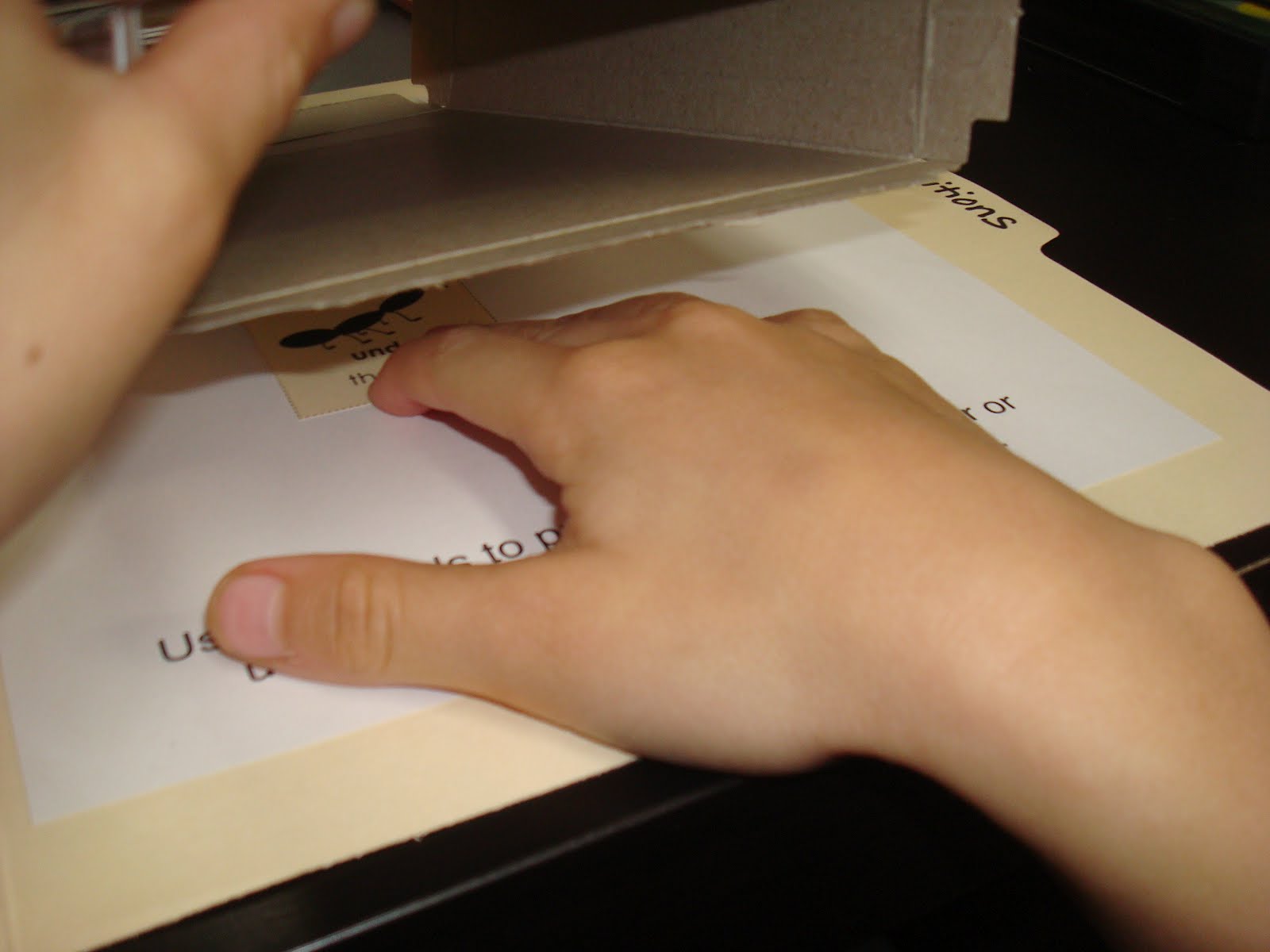
Sometimes we play the game with a chair instead of the box, and Little Man gets on the chair, or crawls under the chair, or runs around the chair, or jumps over the chair.. He loves it when we play the game this way!

As part of each lesson, new words are written on index cards and taught to the student. Before very many lessons have passed, you have enough cards to begin stringing together simple sentences. Our Little Man felt such success when he could begin to read "real" sentences!


So, here's the bottom line:

If you have used another program in the past with great success, and you are comfortable with it, stick with it. Why fix it if it ain't broken? For anyone used to a simpler program (such as myself, who used How to Teach Your Child to Read in 100 Easy Lessons for my other children), PAL does have a lot of moving parts. However, the author, Jill Pike, has done an admirable job of making it as open-and-go as possible (or, as she would say, "fall out of bed easy"!) and it can't be beat in its comprehensive approach to all the arts of language. Also, this uses the sight-sound method of reading instruction, which means that it blends together the benefits of learning phonics with the benefits of learning sight words, so that the student is able to read real sentences very quickly. In my mind, this is a superior method to teaching phonics only (or, heaven forbid, sight words only!).

If you have only one child you are schooling and wish to do a complete lesson, with all its parts, in one day, go for it! But it is very flexible, and can be adapted to your needs and the amount of time you have each day. We now do the reading and writing lesson on one day (about 30 minutes), and the story/literature lesson another day (another 30 minutes). I love that the games, once learned, can be played with an older sibling, and the daily reading sheets can become future reading practice. On extra busy days, that's all the "reading" we do. Review is built in, and all the pieces of reading, writing, spelling, literature, and thinking skills are woven together beautifully.

If you are looking for that type of program, you will be very happy with Primary Arts of Language!

Monday, March 14, 2011

Our Week in Review - Classical Greece

Warning: this is a long post with lots of pictures! I have fallen out of the habit of posting "our week in review" posts, so this is a combination of the last two weeks. I hope to get back in the habit because it's really encouraging to be reminded of all we did accomplish, and also a great way to share our every day school days with loved ones both near and far.

We have been studying the Classical period of Greece recently. The Archaic period (the time of Odysseus, Achilles, the Trojan War, etc) happened several hundred years before the Classical period, but the Classical period is what most people think of when they think of Ancient Greece. It's been fun to study this culture again, adding to the information we gained when we learned about the Archaic period.

I was shocked to realize that the "golden age" of Greece only lasted 47 years!! The culture itself lasted much longer and had far reaching influence on other nations and people groups, even up to the present day, but the "golden age" itself, when the culture was at its height, was very short. I don't remember ever learning that! (I love continuing to learn!)

Another amazing thing for us to learn was how the ancient Israelites, Babylonians, Persians, and Greeks were all tied together. The Israelites were conquered by the Babylonians (leading to the dispursion, or diaspora, of Jews to all other parts of the Middle East). A young man named Daniel was among those Jews sent to Babylon in exile, and he is of course the same Daniel we read about in the Bible, whose friends were thrown into the fiery furnace and miraculously saved by the Lord, who could interpret dreams and who ended up in the lion's den when he was much older (and also survived!).

The Babylonians were very shortly afterward conquered by the Persians (here is where the story of Queen Esther fits in), and the Persians became so great and powerful they decided to try and conquer the Greeks. A series of battles between the Greeks and Persians (known as the Persian Wars) ended with Persia's defeat, stopping the expansion of that empire into Europe. Then there was the "golden age" of Greece, when there was relative peace and the people had time and energy to devote to the development of the arts and sciences. Then followed the Peloponnesian War, between Sparta and Athens, which Sparta won and which began the gradual decline of Greece's greatness. All of this occurred within a span of just 165 years!! This was a huge history puzzle piece that got put in place for me, personally, during our studies.

Last week for virtual co-op, both daughter G and son G had the opportunity to make short power point presentations to share in class, covering an aspect of Greek history. Daughter G, being in virtual co-op for three years now, has made several power points. But it was son G's first time. I am so thrilled for the opportunity our children have to learn these skills early and have years to practice them. He really enjoyed it! He did his presentation on the Peloponnesian War. Here he is making it:


We discussed together (all five children) the similarities and differences between the city-states of Athens and Sparta, and made Venn diagrams to illustrate what we discussed. The ability to compare is another skill I am so thrilled to teach our children early. Everyone made a Venn diagram.....


.....even our kindergartner, Little Man! He drew a picture illustrating something unique to Sparta, something unique to Athens, and something they both shared. Then he dictated to me what they were, and I wrote for him. Click on the picture if you want to see it larger.


Despite the fact that our schoolroom makeover is far from done, it has been functioning very well for us this year. I am so thankful to have more space in which to spread out! At the back of the room we have a small table which is our "extra activities" table. I put some Greek activities on it, and then put a note in each of the children's workboxes to spend time at the activities table.


Many of the activities came from this kit: The Ancient Greece Treasure Chest.


Over the course of the last two weeks, here are some of the activities the children have worked on: (trojan horse is from the Archaic period of Greece, and doesn't belong with our Classical studies, but we made him anyway!)


They each wrote their name in Greek letters, and then stamped a Greek pattern around the edges of their paper.


They also made pictures of a Greek amphora (vase) from a template I had, and decorated them with Greek looking designs and pictures.


Such great practice for Little Man in fine motor skills!


We learned that Athens was the birthplace of democracy ~ government by the people. They instituted a council, and any citizen could serve on the council multiple times during his lifetime (of course, only male non-slaves could be citizens). To vote someone off the council required a certain number of "ostrakons" cast. An ostrakon was a broken piece of pottery, on which a name had been scratched. Many ostrakons have been found by archeologists. We get our word "ostracize" from this word! We decided to make our own ostrakons. I broke up a couple of flower pots to get us started, and that was actually kind-of fun!


The children painted them black.


When the paint was dry, they used a nail to scratch out a name in Greek letters, using this letter wheel from the Ancient Greek Treasure Chest (letter wheel showed roman sounds and their corresponding greek letter).


We ended up with five ostrakons voting Obama out of office! (click on picture to enlarge and see the writing better)


This week we are learning about some specific advances in math, science and philosophy made by the Greeks. We will have another Greek meal this Friday, rather than our usual pizza, and then next week we learn about Alexander the Great conquering the Greeks! (can't believe we are almost up to the time of Christ!)

Thursday, February 10, 2011

A Kindergarten Day

Little Man and I have found a good morning routine that allows me to give him some undivided attention (mostly) to work on math and phonics before he goes to his play mat for the always anticipated "activity time". We start our day with prayer and Bible reading, which also serves as history reading some of the time since we are learning about the ancients this year. After that I work with daughter G for about 15 minutes while Little Man finishes the picture in his Bible journal that goes along with what we read (he's almost always the last one done! That boy loves to draw!). And then it's "our" time.

We work on phonics and math together, and learn Bible verses from his Awana Sparks book. We used to practice writing his name every day, but he has that down really well now.


And then he gets "activity time" while I cycle through working with each of his brothers. The activities change daily. One day a couple weeks ago his activity time was building shapes out of pattern blocks. I gave him about 5 or 6 pictures on heavy cardstock to copy, and then he went to town building his own creations. He asked for the camera, and took some pictures all by himself.


Activity time and play time round out his morning. After lunch and recess we have book time ~ he looks at books for 30 minutes and I read aloud for 30 minutes (to everyone). And then his kindergarten day is done!

Wednesday, February 2, 2011

FIAR Co-op - Katy and the Big Snow, Part 2

Our second week reading Katy and the Big Snow, Lisa highlighted north, south, east, and west directions, which play a major role in the story. The children made directional "keys" (like you see on the bottom of maps) and then we did an activity using the keys.


Then we made snowflake snow globes! Lisa had found small three dimensional snowflake ornaments on clearance after Christmas, and she had the children insert these into a glob of clay that was glued to the underside of a baby food jar lid.


Then we filled the jar with water, leaving about half an inch at the top. We poured a Tbsp of glitter into the water.


We put special water-proof glue on the edges of the jar lid, screwed the lid onto the jar, and then hot glued around the outside edges of the jar.


Voila!


And for our snack, Lisa showed the children how to crush ice and we made snow cones!