First, a warning. This is a long post with lots of pictures. If you want the full explanation, continue reading. Click on pictures to enlarge them and see more detail. If you simply want the bottom line, scroll to the bottom!
The whole program consists of three Teacher Books (one for reading, one for writing, and one for the games that you make as you go), student workpages in the form of e-books to download and print, and a "phonetic farm" folder with stickers that the student puts on one at a time as they are learned.


Here is Little Man with his phonetic farm folder last spring! We started this program very slowly toward the end of his kindergarten year, and are still working through it a year later because that's just the pace that fits our lifestyle at the moment. :0)
 Each day there is a "work page" as part of the lesson. This is the part the child is to do independently. At the beginning the work pages are super easy, such as filling in color names like this:

And then they get progressively harder. Here is one from Lesson 20:

 PAL also utilizes the use of games to reinforce the concepts taught each day, which can be made very simply out of manila file folders. The game "boards" and game pieces are pre-printed and provided. I have heard that some moms make all the games ahead of time, but I have been making them as we come to them. I put the game pieces in a letter sized envelope, and tape this envelope to the back of the file folder. Everything is kept together this way, all ready to play the game the next time! This was a game we played that reinforced a specific spelling rule.
 Here is a game that teaches prepositions. We use an emptied out box (muffins in our case!) to put the pieces under, or on, or in.
 "..the ant is under the box..."
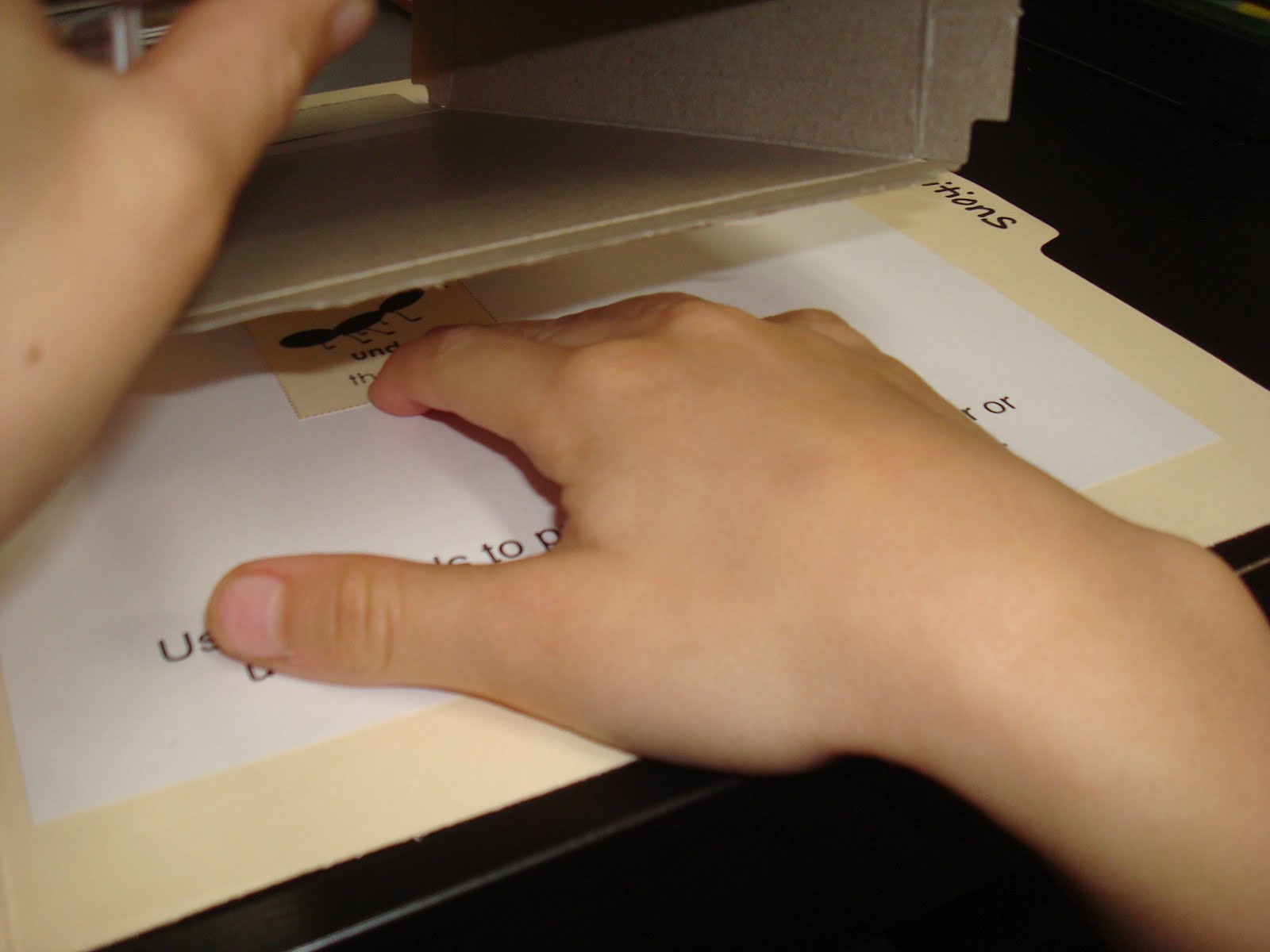 Sometimes we play the game with a chair instead of the box, and Little Man gets on the chair, or crawls under the chair, or runs around the chair, or jumps over the chair.. He loves it when we play the game this way!
 As part of each lesson, new words are written on index cards and taught to the student. Before very many lessons have passed, you have enough cards to begin stringing together simple sentences. Our Little Man felt such success when he could begin to read "real" sentences!
So, here's the bottom line:
If you have used another program in the past with great success, and you are comfortable with it, stick with it. Why fix it if it ain't broken? For anyone used to a simpler program (such as myself, who used How to Teach Your Child to Read in 100 Easy Lessons for my other children), PAL does have a lot of moving parts. However, the author, Jill Pike, has done an admirable job of making it as open-and-go as possible (or, as she would say, "fall out of bed easy"!) and it can't be beat in its comprehensive approach to all the arts of language. Also, this uses the sight-sound method of reading instruction, which means that it blends together the benefits of learning phonics with the benefits of learning sight words, so that the student is able to read real sentences very quickly. In my mind, this is a superior method to teaching phonics only (or, heaven forbid, sight words only!).
If you have only one child you are schooling and wish to do a complete lesson, with all its parts, in one day, go for it! But it is very flexible, and can be adapted to your needs and the amount of time you have each day. We now do the reading and writing lesson on one day (about 30 minutes), and the story/literature lesson another day (another 30 minutes). I love that the games, once learned, can be played with an older sibling, and the daily reading sheets can become future reading practice. On extra busy days, that's all the "reading" we do. Review is built in, and all the pieces of reading, writing, spelling, literature, and thinking skills are woven together beautifully.
If you are looking for that type of program, you will be very happy with Primary Arts of Language!


