I have had a few questions about our new winter schedule posted below, so here is a bit of an explanation and an update on a change I've made already. (yes! already! after only one day...)
Where it says "Bible with Mom", this is our family devotional time and consists of me reading from the Bible outloud to all the children while they draw what I'm reading about in their Bible Journals. After reading, we have prayer time and pray for the persecuted church, missionaries, our relatives, our pastor, and our president. We have a prayer notebook with pictures of many of these people inside, and we hold the pictures as we pray and rotate through them. We finish up this time with hymn singing. We usually learn 1 or sometimes 2 new hymns each week. We don't sing hymns very much anymore at our church, and I LOVE hymns! They are so rich in theology and truth, and the language is often so much more expressive than the language we commonly use today.
After Bible time, our two older children have their own personal quiet time in their rooms. They set a timer for the same number of minutes as their age and are free to read wherever they desire in their own bibles.
IEW stands for Institute for Excellence in Writing, and is the writing curriculum that we use. It is wonderful, I love it, and I wish we had time for it every day, but right now that is just not working for me. So our older two do it together 3 times a week. On the other two days at that same time, our oldest and I study Latin together. We did it today as a matter of fact ~ I was very rusty!!
ETC stands for Explode the Code and is a phonics workbook series.
At lunch time we practice poetry memorization, and at dinner time we dazzle daddy with it! We use another product from IEW called "Linguistic Development Through Poetry Memorization." The kids love doing this, and even our Little Man has learned several poems!
Our daughter, whose color is red, has "History Reading, AQ's and TQ's" after lunch. AQ's stand for accountability questions and TQ's stand for thinking questions. This is part of our history curriculum, Tapestry of Grace, and are questions that can either be answered from her reading or that require a little thought and input from her own mind. She is learning to answer them as she reads as opposed to answering them all in one day after she has done all the reading and forgotton what she read 3 days earlier.
Before we started back to school yesterday, I told the children about the new schedule, and that chores would now have to be done BEFORE having breakfast. The children gave me shocked looks, but when my hubby told them that if we lived on a farm they would probably do chores for about an hour before eating, they were quite content to do their one little 10 minute cleaning job. Problem was, not everyone finished at the same time. So two of the children were still eating breakfast at 9:00 when it was time to begin our Bible time. Since this is something that we all do together, the rest of us had to wait for them.
So last night at dinner, we told the children that not only would they have to do their chore before being allowed to eat breakfast, the kitchen and dining room would be closing at 9:00, and all food and dishes would need to be cleared at that time. We heard gasps, and "how come you are being so mean?". Wellllllll, what a pleasant surprise this morning to see ALL of the children getting dressed as quickly as possible, making their beds, and hi-tailing it downstairs to do their chore before I had even finished putting in my contacts!! They wanted to be sure they had plenty of time to EAT! :-)
I have found the secret. Food is a powerful motivator!!!
I am thankful for two days of accomplishing much, and pray that this new schedule will continue to help keep us on track.
Showing posts with label homeschooling journey. Show all posts
Showing posts with label homeschooling journey. Show all posts
Tuesday, January 6, 2009

Monday, January 5, 2009
New School Schedule (part 14)
One of my big projects over the Christmas break was making a new schedule for our school routine. I have had a MOTH schedule for many years. MOTH stands for Manager Of Their Homes, and is a scheduling tool originally made for larger families by Teri Maxwell of the Titus2 website. The book itself was extremely helpful for me to read and think through BEFORE attempting to make my first schedule. It helped me think through all of the things that needed to get done in a given day or even during the year (like those once a year cleaning jobs), and how to organize the children, myself, and my home so that all of the needed things could be accomplished. If you struggle with "getting it all done" I highly recommend this book!
Something else the book helped me with was figuring out what every member of the family would be doing at any given time. If I wanted to have a reading lesson when our oldest was in kindergarten, what would I do with the baby during this time? Where would the 2 year old and 3 year old be, and how could I best ensure that the reading lesson would not be interrupted?
Even though this book and scheduling tool were extremely helpful to me, I used (and still use) my schedule as more of a "routine" than a strict schedule. I did not want to overschedule every single minute. So for a few years my nicely color coded MOTH schedule taped to the fridge just said "school" for the 9-12 time slot for the school aged children. This worked well for quite a while, but this past fall we all struggled alot with our routine, me probably more than anyone. We started late. We didn't get our chores finished in a timely manner. Having 4 working at the same table meant that me and the student I was working with at the time were often interrupted. Our 6th grader and I were seldom doing Latin. Once we made it to lunch, I would often give the children an extra long recess, wanting to give our youngest as much outside play time as possible before his nap. That meant that we weren't finishing school until dinner time. This was a bummer for all of us. I knew in my heart that we could do better, and I had it in mind to make a new schedule that for a while was very tight - every subject scheduled out - so we could see how long things were actually taking and whether or not our allotted times were realistic. But I never had the time to do it.
Re-thinking the schedule and creating it in large poster form that all the children could read and follow throughout the day was one of my major goals during our break from school, and I am thankful to say that I got it done! We have had "family colors" for years, with everything color coded from notebooks to toothbrushes, so everyone is very used to looking for their color (I am "plum for mum"!). Today was our first day following the new schedule, and so far it is working GREAT! The children are enjoying recess as I type this. :-)
Here is our new schedule on a poster hanging prominently in our school room (the kitchen eating area). I am sure we will have a few kinks to work out, like when piano lessons alter our afternoon schedule, but I'm thankful to have a little poster to be accountable to. Just knowing it is there, and that the children are checking it frequently, is helping me to stay focused. If we can all stay focused enough throughout the day, we can finish by 2:30 or 3:00!!

You can click on the poster to see it larger. I don't know how long we will use it as is, so strictly scheduled, but probably as long as it takes us to build better habits. I have tried to work it so that when I am working on something brain-intensive with one child (like a reading lesson with 6 year old C, whose color is yellow) the others are doing things that they can do independently. We'll see how it all pans out. Okay now, off to do booktime with the younger two!
Something else the book helped me with was figuring out what every member of the family would be doing at any given time. If I wanted to have a reading lesson when our oldest was in kindergarten, what would I do with the baby during this time? Where would the 2 year old and 3 year old be, and how could I best ensure that the reading lesson would not be interrupted?
Even though this book and scheduling tool were extremely helpful to me, I used (and still use) my schedule as more of a "routine" than a strict schedule. I did not want to overschedule every single minute. So for a few years my nicely color coded MOTH schedule taped to the fridge just said "school" for the 9-12 time slot for the school aged children. This worked well for quite a while, but this past fall we all struggled alot with our routine, me probably more than anyone. We started late. We didn't get our chores finished in a timely manner. Having 4 working at the same table meant that me and the student I was working with at the time were often interrupted. Our 6th grader and I were seldom doing Latin. Once we made it to lunch, I would often give the children an extra long recess, wanting to give our youngest as much outside play time as possible before his nap. That meant that we weren't finishing school until dinner time. This was a bummer for all of us. I knew in my heart that we could do better, and I had it in mind to make a new schedule that for a while was very tight - every subject scheduled out - so we could see how long things were actually taking and whether or not our allotted times were realistic. But I never had the time to do it.
Re-thinking the schedule and creating it in large poster form that all the children could read and follow throughout the day was one of my major goals during our break from school, and I am thankful to say that I got it done! We have had "family colors" for years, with everything color coded from notebooks to toothbrushes, so everyone is very used to looking for their color (I am "plum for mum"!). Today was our first day following the new schedule, and so far it is working GREAT! The children are enjoying recess as I type this. :-)
Here is our new schedule on a poster hanging prominently in our school room (the kitchen eating area). I am sure we will have a few kinks to work out, like when piano lessons alter our afternoon schedule, but I'm thankful to have a little poster to be accountable to. Just knowing it is there, and that the children are checking it frequently, is helping me to stay focused. If we can all stay focused enough throughout the day, we can finish by 2:30 or 3:00!!

You can click on the poster to see it larger. I don't know how long we will use it as is, so strictly scheduled, but probably as long as it takes us to build better habits. I have tried to work it so that when I am working on something brain-intensive with one child (like a reading lesson with 6 year old C, whose color is yellow) the others are doing things that they can do independently. We'll see how it all pans out. Okay now, off to do booktime with the younger two!
Thursday, October 30, 2008
How to Encourage Independent Learning (part 13)
I originally wrote the following in response to someone on the Tapestry Of Grace yahoo group who had a 7 year old and was wondering how she could encourage him to learn to work more independently. My friends Guinever and Beth encouraged me to also post this on my blog, so here it is! These are a few of the things we have done/are doing to encourage independence. Hope it is helpful for someone!
1. Try to find and keep the balance between expecting too much and expecting too little. Independence in schoolwork is a learned skill, and he *is* just 7. Our now 8 year old has made a big improvement over last year, and last year he could do NOTHING without me right there! So take heart! A lot of it is maturity and comes with time.
2. Find what motivates him and use it. For us, the timer and the nickel reward system have been the biggest motivators. My 8 and 9 year old boys are very slow with their math work. They can do it, but they daydream and distract themselves. A few weeks ago I started setting the timer for 30 minutes and saying that when the timer dinged we were moving on to other things even if their math was not done. Then in the afternoon when they could be having free time, they'd have to finish their math on their own time. This has kept us all from having to wait for the slow pokes. A "positive" reward is to give 5 extra nickels to the person who finishes BEFORE the timer dings (or before the long hand gets to the 12 or whatever). My children are beginning to be strongly motivated by money, so this works! (they get 10 nickels at the start of each day anyway, so these are in addition to that)
3. Organize your own duties in such a way that you can give him 30 minute chunks of uninterrupted time. Pick his easiest task, one you know he will be successful at, and sit there quietly next to him doing your own paperwork while he does it on his own. Then afterward, give him LOTS of praise and point out to him how capable he is! This kind of message playing in his head day after day after day will help give him the confidence he needs to try more things "on
his own".
4. Show him an earlier page in a certain book (math or whatever) and talk about how when he first started doing that it seemed so hard, but now it's easy. (we did this just this morning with 8 year old's math book - he was encouraged to see his progress for himself!)
5. Be willing to consider a change in certain curriculum to something that is more measurable for him. Example: last year we used copywork for our then 7 year old's handwriting practice (plus I was trying to be more Charlotte Mason-ish). His handwriting was atrocious and he hated doing copywork. This year we switched back to a more traditional handwriting workbook and he is happier because he can see exactly how each letter is to be formed and how many lines he
has to complete until he is done for the day. And his handwriting is much better!
6. Make and use a daily assignment sheet. Teach him (over the course of many weeks, day after day after day) how to cross off the boxes when he completes that task. Consider giving him a small reward (such as extra computer time or whatever works for your family) if he completes the entire column for that day. I have grouped all the language arts type things together on our 8 year old's assignment sheet and given them a light blue background color so that he can easily see which things in that group he still needs to do. All of his TOG work (which isn't much) is light green, and so on. Colors seem to help him.
7. Commit to checking his daily assignment sheet at least twice a day, we do before lunch and mid afternoon (when they tell me they're done). Sometimes life gets so busy that I forget to check up on how well they are following their assignment sheets, so this is something I am working on as well!
Remember, learning to work independently is a process that we are all in together, so take comfort knowing you are not alone!
1. Try to find and keep the balance between expecting too much and expecting too little. Independence in schoolwork is a learned skill, and he *is* just 7. Our now 8 year old has made a big improvement over last year, and last year he could do NOTHING without me right there! So take heart! A lot of it is maturity and comes with time.
2. Find what motivates him and use it. For us, the timer and the nickel reward system have been the biggest motivators. My 8 and 9 year old boys are very slow with their math work. They can do it, but they daydream and distract themselves. A few weeks ago I started setting the timer for 30 minutes and saying that when the timer dinged we were moving on to other things even if their math was not done. Then in the afternoon when they could be having free time, they'd have to finish their math on their own time. This has kept us all from having to wait for the slow pokes. A "positive" reward is to give 5 extra nickels to the person who finishes BEFORE the timer dings (or before the long hand gets to the 12 or whatever). My children are beginning to be strongly motivated by money, so this works! (they get 10 nickels at the start of each day anyway, so these are in addition to that)
3. Organize your own duties in such a way that you can give him 30 minute chunks of uninterrupted time. Pick his easiest task, one you know he will be successful at, and sit there quietly next to him doing your own paperwork while he does it on his own. Then afterward, give him LOTS of praise and point out to him how capable he is! This kind of message playing in his head day after day after day will help give him the confidence he needs to try more things "on
his own".
4. Show him an earlier page in a certain book (math or whatever) and talk about how when he first started doing that it seemed so hard, but now it's easy. (we did this just this morning with 8 year old's math book - he was encouraged to see his progress for himself!)
5. Be willing to consider a change in certain curriculum to something that is more measurable for him. Example: last year we used copywork for our then 7 year old's handwriting practice (plus I was trying to be more Charlotte Mason-ish). His handwriting was atrocious and he hated doing copywork. This year we switched back to a more traditional handwriting workbook and he is happier because he can see exactly how each letter is to be formed and how many lines he
has to complete until he is done for the day. And his handwriting is much better!
6. Make and use a daily assignment sheet. Teach him (over the course of many weeks, day after day after day) how to cross off the boxes when he completes that task. Consider giving him a small reward (such as extra computer time or whatever works for your family) if he completes the entire column for that day. I have grouped all the language arts type things together on our 8 year old's assignment sheet and given them a light blue background color so that he can easily see which things in that group he still needs to do. All of his TOG work (which isn't much) is light green, and so on. Colors seem to help him.
7. Commit to checking his daily assignment sheet at least twice a day, we do before lunch and mid afternoon (when they tell me they're done). Sometimes life gets so busy that I forget to check up on how well they are following their assignment sheets, so this is something I am working on as well!
Remember, learning to work independently is a process that we are all in together, so take comfort knowing you are not alone!
Sunday, September 7, 2008
Homeschool Encouragement (part 12)
My previous post (Debunking some Homeschool Myths) may have comforted veteran homeschoolers with the knowledge that they are not alone, but it also may have freaked out some new homeschoolers (what??! I'm going to be exhausted all the time and have to serve frozen waffles for dinner?). So on the flip side, here are some of the things I love about homeschooling and some of the ways it has blessed me.
1. I love, love, love spending so much time with my children! Not only are they (usually) a blessing to me, but I can more easily see those areas that we need to work on. I see lots of subtleties in the way they relate to their siblings that I would miss if they were gone all day, and I know so much more specifically how to pray for them.
2. I love, love, love learning along with my children!! Absolutely love it! This past week I started learning latin. Who knew that a 46 year old could tackle latin and love it? It's going to be challenging, but I figure that my brain cells need the challenge probably more than my daughter's brain cells do. :-)
3. Since we have homeschooled from the beginning and added to our family twice since our oldest started school, I have so enjoyed watching the older children be home to love on the new babies and develop relationships with their younger siblings. Precious, precious snapshot memories for me.
4. I love that we can still do school if someone is a little bit sick. We miss very few days and I believe that we actually school much more than our public school counterparts.
5. I love that we have flexibility to our schedule and can take school on the road, to the library, to the Dr's office, even to Sam's Club!
6. Homeschooling has shown me my own weaknesses, and how much I need to depend on the Lord. It has grown my faith tremendously, as I've watched God work in my life and the lives of our children throughout this adventure so far.
7. We have opportunities to serve others during the day, to focus on "life skills" (code words for spending a day furiously cleaning the house or going grocery shopping!), to cook together, to go on fun field trips, or to surprise daddy with a fun picnic lunch at work.
8. When I am sick, I do not need to go out of the house ALL DAY LONG! No dropping off or picking up at school, no need to be presentable for anyone but my own family. I can wear my pajamas all day and direct their schooling from the couch. Or we can just do video school that day!
9. Homeschooling has made my hubby and I work together as partners in the education of our children. He trusts me to think through curriculum choices, and what programs and activities would be best for each of our children, and I trust him to carefully weigh the options I present to him and to take our decisions to the Lord in prayer together. I love that we are a team!
10. We have no waiting in line to go out for recess, no waiting for everyone to catch up before we can move on to something else, and we don't have to move on too quickly before everyone has "gotton" it. We get so much more accomplished each day and we can go at our own pace!
11. I have lots of helpers when I make those frozen waffles. :-)
12. I have met many of my favorite people through homeschooling. There are some awesome, awesome homeschoolers out there who willingly share their experience and wisdom with others!
13. We are able to take some extra curricular classes during the day when most others are in school.
14. We have been able to take field trips and family vacations at times when venues are less crowded.
15. It has provided me with AMPLE opportunities to practice my gifts and strengths (organization and administration are among them, though if you were to glance inside my house at any given time you may not think I am very organized!). Nothing I have ever done has given me as much pleasure and reward as homeschooling.
To any new readers and/or new homeschoolers......you will be happy to know that we have not had frozen waffles for dinner in well over a month. Even with my broken finger! Last week we had two very wonderful and exceptionally healthy dinners (the rest were average, but at least they were not frozen waffles). Some days I am quite full of energy and feel like the energizer bunny all day long. Some days I do exercise (with the children usually), and most of the time I am able to give my hubby some undivided attention without distraction. The homeschooling lifestyle is hard because it is so constant, but it is also very, very good.
1. I love, love, love spending so much time with my children! Not only are they (usually) a blessing to me, but I can more easily see those areas that we need to work on. I see lots of subtleties in the way they relate to their siblings that I would miss if they were gone all day, and I know so much more specifically how to pray for them.
2. I love, love, love learning along with my children!! Absolutely love it! This past week I started learning latin. Who knew that a 46 year old could tackle latin and love it? It's going to be challenging, but I figure that my brain cells need the challenge probably more than my daughter's brain cells do. :-)
3. Since we have homeschooled from the beginning and added to our family twice since our oldest started school, I have so enjoyed watching the older children be home to love on the new babies and develop relationships with their younger siblings. Precious, precious snapshot memories for me.
4. I love that we can still do school if someone is a little bit sick. We miss very few days and I believe that we actually school much more than our public school counterparts.
5. I love that we have flexibility to our schedule and can take school on the road, to the library, to the Dr's office, even to Sam's Club!
6. Homeschooling has shown me my own weaknesses, and how much I need to depend on the Lord. It has grown my faith tremendously, as I've watched God work in my life and the lives of our children throughout this adventure so far.
7. We have opportunities to serve others during the day, to focus on "life skills" (code words for spending a day furiously cleaning the house or going grocery shopping!), to cook together, to go on fun field trips, or to surprise daddy with a fun picnic lunch at work.
8. When I am sick, I do not need to go out of the house ALL DAY LONG! No dropping off or picking up at school, no need to be presentable for anyone but my own family. I can wear my pajamas all day and direct their schooling from the couch. Or we can just do video school that day!
9. Homeschooling has made my hubby and I work together as partners in the education of our children. He trusts me to think through curriculum choices, and what programs and activities would be best for each of our children, and I trust him to carefully weigh the options I present to him and to take our decisions to the Lord in prayer together. I love that we are a team!
10. We have no waiting in line to go out for recess, no waiting for everyone to catch up before we can move on to something else, and we don't have to move on too quickly before everyone has "gotton" it. We get so much more accomplished each day and we can go at our own pace!
11. I have lots of helpers when I make those frozen waffles. :-)
12. I have met many of my favorite people through homeschooling. There are some awesome, awesome homeschoolers out there who willingly share their experience and wisdom with others!
13. We are able to take some extra curricular classes during the day when most others are in school.
14. We have been able to take field trips and family vacations at times when venues are less crowded.
15. It has provided me with AMPLE opportunities to practice my gifts and strengths (organization and administration are among them, though if you were to glance inside my house at any given time you may not think I am very organized!). Nothing I have ever done has given me as much pleasure and reward as homeschooling.
To any new readers and/or new homeschoolers......you will be happy to know that we have not had frozen waffles for dinner in well over a month. Even with my broken finger! Last week we had two very wonderful and exceptionally healthy dinners (the rest were average, but at least they were not frozen waffles). Some days I am quite full of energy and feel like the energizer bunny all day long. Some days I do exercise (with the children usually), and most of the time I am able to give my hubby some undivided attention without distraction. The homeschooling lifestyle is hard because it is so constant, but it is also very, very good.
Thursday, September 4, 2008
Debunking some homeschool myths (part 11)
As with any subculture of our society , there are many stereotypes and perceptions about homeschoolers that are floating around out there in the general population. Some of them are rather funny (we all wear denim jumpers and braided hair and have large families) while others are of a more serious nature (we all have the patience of Job). Homeschoolers themselves are not immune from falling for some of these misperceptions. We all think that some other homeschool mom "has it all together" and if we could only be like her, we'd be all set. You know the mom I mean, the homeschool version of the Proverbs 31 woman.
She is up at dawn (or before) to exercise and spend an hour reading her Bible and praying. She makes healthy lunches for her husband to take to work. She is always freshly showered and makeuped (is that a word?) and greets the children each morning with a lovely smile and encouraging words. Her home is always clean and even her closets are organized. She is always prepared for school with awesome lesson plans and her children always love to do their schoolwork and are always obedient. They study latin, read voraciously, take violin lessons and advanced math, and still manage to be finished with school by noon, after which they are free to pursue their own interests (such as starting their own business at age 13). She prepares delicious, nutritious dinners each night that are served on a beautifully set table and right on time. To top it all off, she has enough energy left at the end of the day to be frisky with her husband, who is tremendously content and always feels blessed to be married to her.
Well, I am not this woman.
And this may come as a newsflash to some of you, but I have never met this woman and I do not believe that she exists! There are times that I desperately cling to this ideal, and there are parts of this woman that I relate to, but the truth of the matter is that no-one has it all together as we like to think they do. No-one.
Here are some of my realities, shared in the sincere hope that it makes some of you feel better! :-)
1. I do not rise early. By early I mean seldom before 7:00 and often not until 8:00. Some days I only get up then because it's time to wake the kids, and sometimes they wake me up first!
2. My exercise is sporadic. I know I should work out regularly, but I don't.
3. Despite my best laid plans, sometimes dinner is frozen waffles. Served on paper plates.
4. I do bake our bread, except during times when our life is very busy or there's too much stuff on the counter to use my mixer, or I have a splint on my finger. We've been in a spell like that for the last 3 months.
5. I am not always a motivated homeschool mom and therefore need outside accountability. This year I am teaching science at co-op so that I will have to do it!
6. Sometimes we don't finish schoolwork until dinnertime. Or after.
7. Sometimes we finish schoolwork by early afternoon but the character issues take all day and wear. me. out.
8. My husband rarely gets home before 7:30 p.m. and we have precious little family time other than weekends.
9. There are many nights when my husband and I both fall into bed exhausted and are asleep almost as soon as our heads hit our pillows. Forget frisky. We're talking catatonic.
10. Some days my personal devotions consist of popcorn prayers and a 2 minute devotional read while in the bathroom.
11. I haven't dusted our living room since Easter.
12. I love our homeschool lifestyle, but there are days when I get very discouraged and feel like a failure as a teacher and a mom.
~~~~~~~~~~~~~~~~~~~~~~~~~
The reality of our chosen lifestyle and the day to day of our family dynamic is sometimes hard. But consider this encouragement from God's Word:
"In this world you will have trouble, but take heart! I have overcome the world." (John 16:33)
"I have learned to be content whatever the circumstances...... I have learned the secret of being content in any and every situation........ I can do everything through Him who gives me strength." (Philippians 4:11-13)
"My grace is sufficient for you, for my power is made perfect in weakness (Jesus said). Therefore I will boast all the more gladly about my weaknesses, so that Christ's power may rest on me.....for when I am weak, then I am strong." (2 Corinthians 12:9-10)
How I thank God for His daily strength and grace! Despite the reality of having no shower some days, and my 3 year old potty training Little Man peeing through three outfits before lunch, these days are among the sweetest of my life, and I wouldn't trade them for the world!
She is up at dawn (or before) to exercise and spend an hour reading her Bible and praying. She makes healthy lunches for her husband to take to work. She is always freshly showered and makeuped (is that a word?) and greets the children each morning with a lovely smile and encouraging words. Her home is always clean and even her closets are organized. She is always prepared for school with awesome lesson plans and her children always love to do their schoolwork and are always obedient. They study latin, read voraciously, take violin lessons and advanced math, and still manage to be finished with school by noon, after which they are free to pursue their own interests (such as starting their own business at age 13). She prepares delicious, nutritious dinners each night that are served on a beautifully set table and right on time. To top it all off, she has enough energy left at the end of the day to be frisky with her husband, who is tremendously content and always feels blessed to be married to her.
Well, I am not this woman.
And this may come as a newsflash to some of you, but I have never met this woman and I do not believe that she exists! There are times that I desperately cling to this ideal, and there are parts of this woman that I relate to, but the truth of the matter is that no-one has it all together as we like to think they do. No-one.
Here are some of my realities, shared in the sincere hope that it makes some of you feel better! :-)
1. I do not rise early. By early I mean seldom before 7:00 and often not until 8:00. Some days I only get up then because it's time to wake the kids, and sometimes they wake me up first!
2. My exercise is sporadic. I know I should work out regularly, but I don't.
3. Despite my best laid plans, sometimes dinner is frozen waffles. Served on paper plates.
4. I do bake our bread, except during times when our life is very busy or there's too much stuff on the counter to use my mixer, or I have a splint on my finger. We've been in a spell like that for the last 3 months.
5. I am not always a motivated homeschool mom and therefore need outside accountability. This year I am teaching science at co-op so that I will have to do it!
6. Sometimes we don't finish schoolwork until dinnertime. Or after.
7. Sometimes we finish schoolwork by early afternoon but the character issues take all day and wear. me. out.
8. My husband rarely gets home before 7:30 p.m. and we have precious little family time other than weekends.
9. There are many nights when my husband and I both fall into bed exhausted and are asleep almost as soon as our heads hit our pillows. Forget frisky. We're talking catatonic.
10. Some days my personal devotions consist of popcorn prayers and a 2 minute devotional read while in the bathroom.
11. I haven't dusted our living room since Easter.
12. I love our homeschool lifestyle, but there are days when I get very discouraged and feel like a failure as a teacher and a mom.
~~~~~~~~~~~~~~~~~~~~~~~~~
"In this world you will have trouble, but take heart! I have overcome the world." (John 16:33)
"I have learned to be content whatever the circumstances...... I have learned the secret of being content in any and every situation........ I can do everything through Him who gives me strength." (Philippians 4:11-13)
"My grace is sufficient for you, for my power is made perfect in weakness (Jesus said). Therefore I will boast all the more gladly about my weaknesses, so that Christ's power may rest on me.....for when I am weak, then I am strong." (2 Corinthians 12:9-10)
How I thank God for His daily strength and grace! Despite the reality of having no shower some days, and my 3 year old potty training Little Man peeing through three outfits before lunch, these days are among the sweetest of my life, and I wouldn't trade them for the world!
Tuesday, July 1, 2008
More on binding your own books (part 10)
MarshaAnne asked about my comb binding machine, and I decided to answer in a whole new post since my answer is rather long winded. Ha!
I purchased my machine online from The Binding Machine. It was a discontinued model that was regularly priced well over $100 and selling for $25. I don't see it on their website anymore, since it's discontinued, but it is most similar to this one.
Shortly after purchasing, my friend Angi made me aware of the ProClick binding machine, which allows for pages to be added at the point of insertion rather than having to be added to the front or taking all the pages out to add them to the back. If I were buying now, this is the machine I would get.
Since I already have a regular comb binding machine, I am going to invest in some of these spines, which open and close to allow for insertion of forgotton pages, but work with a regular binding machine rather than a ProClick. This concept of creating my own comb bound books is a relatively new one to me, but I am excited about the possibilities!
And I must take this opportunity to put in a plug for my friend Angi's blog. If you are a homeschooler, you will find lots of helpful info and tips here! Angi does have an amazon page where you can purchase ProClick supplies. Believe me, you'll want some after seeing what she and her daughter have done with them! There is a link on her blog.
I purchased my machine online from The Binding Machine. It was a discontinued model that was regularly priced well over $100 and selling for $25. I don't see it on their website anymore, since it's discontinued, but it is most similar to this one.
Shortly after purchasing, my friend Angi made me aware of the ProClick binding machine, which allows for pages to be added at the point of insertion rather than having to be added to the front or taking all the pages out to add them to the back. If I were buying now, this is the machine I would get.
Since I already have a regular comb binding machine, I am going to invest in some of these spines, which open and close to allow for insertion of forgotton pages, but work with a regular binding machine rather than a ProClick. This concept of creating my own comb bound books is a relatively new one to me, but I am excited about the possibilities!
And I must take this opportunity to put in a plug for my friend Angi's blog. If you are a homeschooler, you will find lots of helpful info and tips here! Angi does have an amazon page where you can purchase ProClick supplies. Believe me, you'll want some after seeing what she and her daughter have done with them! There is a link on her blog.
Thursday, June 26, 2008
Record Keeping and Storage (part 9)
Thankfully, we live in a state that is currently very friendly toward homeschoolers and does not require record keeping or reporting of any kind. We know, however, that this could change at any time, so we have chosen to keep a record of the work we have done should we ever be legally required to show it. It's also good for our own benefit, to be able to look at a record of our work and say, "oh, that's what we did all year!"
In our family, we don't keep official grades for every subject until sixth grade (as in, writing down the grade of all assignments in a grade book of some kind and giving a letter grade for the class overall). Since our oldest just completed fifth grade, I have not had to keep a grade book yet. That will be something new this next year.
This past spring I was able to purchase a comb binding machine during a really good sale, and I made a comb bound book for each of the three older children of all their daily assignment sheets for the entire year. Each book is literally 36 pages that shows what they did each day in every subject.
 I also made comb bound books of all their work in history, geography, literature, and writing. We used file folders for the front and back covers, in each of our children's assigned colors of course! :-)
In our family, we don't keep official grades for every subject until sixth grade (as in, writing down the grade of all assignments in a grade book of some kind and giving a letter grade for the class overall). Since our oldest just completed fifth grade, I have not had to keep a grade book yet. That will be something new this next year.
This past spring I was able to purchase a comb binding machine during a really good sale, and I made a comb bound book for each of the three older children of all their daily assignment sheets for the entire year. Each book is literally 36 pages that shows what they did each day in every subject.
I also made comb bound books of all their work in history, geography, literature, and writing. We used file folders for the front and back covers, in each of our children's assigned colors of course! :-)
These books hold everything from mapwork,

to coloring pages,

to writing,


to homemade charts. This is a homemade flow chart showing the 3 branches of government as set forth in the constitution.

Our daughter has a separate writing notebook where she has chosen to keep all her completed writing assignments, but our son G has his writing for the year in this comb bound book. Here is an example of a key word outline, which we learned how to make from our excellent writing curriculum, Institute for Excellence in Writing.
 After making his key word outline from a paragraph in one of our history books, he closed the book and rewrote the paragraph from his outline. Here is his version of the paragraph:

Each of our children has completed a writing book called All About Me during their third grade year, and I think these books are destined to become treasured keepsakes! Each page asks a question or two about the student's life, and when the book is finished it is a record of many of that child's favorite sports, memories, things to do, vacation spots, family activities, subjects in school, and daily habits.
 These comb bound books, plus the All About Me book, and the colonial lapbooks we did earlier this year are the sum total of what I am keeping as a record of this past year. It takes up this much space:
 I have a labeler which I will use to label all the comb bound spines so that I can tell what they are when they are sitting on the shelf (in our basement). All of the workbooks go in the paper recycling bag, and all the hands on projects, once they are properly photographed and oohed and aahed over, go in the trash!
 After making his key word outline from a paragraph in one of our history books, he closed the book and rewrote the paragraph from his outline. Here is his version of the paragraph:
Each of our children has completed a writing book called All About Me during their third grade year, and I think these books are destined to become treasured keepsakes! Each page asks a question or two about the student's life, and when the book is finished it is a record of many of that child's favorite sports, memories, things to do, vacation spots, family activities, subjects in school, and daily habits.
 These comb bound books, plus the All About Me book, and the colonial lapbooks we did earlier this year are the sum total of what I am keeping as a record of this past year. It takes up this much space:
 I have a labeler which I will use to label all the comb bound spines so that I can tell what they are when they are sitting on the shelf (in our basement). All of the workbooks go in the paper recycling bag, and all the hands on projects, once they are properly photographed and oohed and aahed over, go in the trash!
 Monday, June 9, 2008
Homeschool Organization (part 8)
Much has been written about organization in general, and homeschool organization in particular. I do not claim to be an expert in this area, but I will share the two organizational principles that have helped me tremendously.
1. A place for everything and everything in its place. This is an oft repeated adage, but it's really true! If you can make a designated "home" for every item in your house, and teach everyone where an item's home is, it is so much easier to pick up and keep your house looking neat. I confess that I do not have this one "down" yet, but I'm working on it. In fact, I think it's going to be a life long project for me, because just when I finish cleaning and organizing the last room in the house, the first one needs to be done again! Purging, discarding, and making homes for everything that remains is a great guiding principle for me though, and it works everywhere, not just in the schoolroom.
2. Store or keep items as close as possible to where you are going to be using them. This simple tip has also helped me tremendously and saved a lot of time over the years.
Each family's housing situation, space limitations, and storage options are different, so you will have to pray and think (sometimes outside the box!) and figure out what works best for you. For us, this is what our school organization looks like:
We do school primarily in our kitchen and family room. I have sometimes longed for a dedicated schoolroom, and may someday turn our small finished basement into a schoolroom, but since we use the basement as our toyroom right now and will need to continue this for at least a few more years, it just works better to have school in our kitchen. We also have a dining room where we eat all our meals, so the kitchen table does not have to be cleared off repeatedly throughout the day. For this I am very thankful.
My hubby made me a school cubbie unit a few years ago, with 6 cubbies in it. This is our primary piece of school furniture. The 4 older children each painted their cubbie in their own color (we have a color coding system in our family which we have used for years and everyone knows very well!) and I got two of them for my teacher materials (painted plum for mum!). I will eventually have to give one of these up to our youngest, but for now it's extra storage for me! Extra books, binders, and a small file box sit on top of the cubbie unit. To the right of the cubbie unit, way down on the floor you will see part of a laundry basket. This is the home for all our library books. We have so many books in our house, it's just imperative that we keep our library and home books separate (ask me how I know). To the left of the cubbie unit, out of the picture, is the rest of my kitchen. You know, the part we use for cooking. ;-)
In each cubbie unit lives what we call a "book holder" ~ it is a cardboard magazine holder that we use for daily workbooks to stand up in. They also each have their own binder with several divided sections in it for history, literature, writing and mapwork, though our oldest is the only one who uses hers daily.
Directly opposite the school cubbie is our craft cupboard, which is a small set of kitchen cupboards (upper and lower) that we have purposed for arts and crafts. It was too messy today for me to take a picture of it!

Here is a close up of the file box that lives on top of our cubbie unit. I have plain file folders labeled 1-36. These are for each week of our school year. Anything pertaining to a given week goes in these folders. They are largely used for our Tapestry work, but other items go in them too, such as history related coloring pages for the younger ones to color while I read, or lab sheets for a science experiment. I have colored folders in the back, in each of my children's assigned colors, that hold finished or in progress work for each of the children.

It is fastened to the ceiling with large keychain clips, so that in the summer time I can unclip the white board in order to more fully use the window, and all that shows are the small eye screws.
 We have very little wall space in this area, because one whole side is open to our family room and the other walls have either windows or kitchen cabinets on them. My entire available wall space is this on one side of the table....

1. A place for everything and everything in its place. This is an oft repeated adage, but it's really true! If you can make a designated "home" for every item in your house, and teach everyone where an item's home is, it is so much easier to pick up and keep your house looking neat. I confess that I do not have this one "down" yet, but I'm working on it. In fact, I think it's going to be a life long project for me, because just when I finish cleaning and organizing the last room in the house, the first one needs to be done again! Purging, discarding, and making homes for everything that remains is a great guiding principle for me though, and it works everywhere, not just in the schoolroom.
2. Store or keep items as close as possible to where you are going to be using them. This simple tip has also helped me tremendously and saved a lot of time over the years.
Each family's housing situation, space limitations, and storage options are different, so you will have to pray and think (sometimes outside the box!) and figure out what works best for you. For us, this is what our school organization looks like:
We do school primarily in our kitchen and family room. I have sometimes longed for a dedicated schoolroom, and may someday turn our small finished basement into a schoolroom, but since we use the basement as our toyroom right now and will need to continue this for at least a few more years, it just works better to have school in our kitchen. We also have a dining room where we eat all our meals, so the kitchen table does not have to be cleared off repeatedly throughout the day. For this I am very thankful.
My hubby made me a school cubbie unit a few years ago, with 6 cubbies in it. This is our primary piece of school furniture. The 4 older children each painted their cubbie in their own color (we have a color coding system in our family which we have used for years and everyone knows very well!) and I got two of them for my teacher materials (painted plum for mum!). I will eventually have to give one of these up to our youngest, but for now it's extra storage for me! Extra books, binders, and a small file box sit on top of the cubbie unit. To the right of the cubbie unit, way down on the floor you will see part of a laundry basket. This is the home for all our library books. We have so many books in our house, it's just imperative that we keep our library and home books separate (ask me how I know). To the left of the cubbie unit, out of the picture, is the rest of my kitchen. You know, the part we use for cooking. ;-)
In each cubbie unit lives what we call a "book holder" ~ it is a cardboard magazine holder that we use for daily workbooks to stand up in. They also each have their own binder with several divided sections in it for history, literature, writing and mapwork, though our oldest is the only one who uses hers daily.
Directly opposite the school cubbie is our craft cupboard, which is a small set of kitchen cupboards (upper and lower) that we have purposed for arts and crafts. It was too messy today for me to take a picture of it!
Here is a close up of the file box that lives on top of our cubbie unit. I have plain file folders labeled 1-36. These are for each week of our school year. Anything pertaining to a given week goes in these folders. They are largely used for our Tapestry work, but other items go in them too, such as history related coloring pages for the younger ones to color while I read, or lab sheets for a science experiment. I have colored folders in the back, in each of my children's assigned colors, that hold finished or in progress work for each of the children.

Above the cubbie unit hangs our white board.

It is fastened to the ceiling with large keychain clips, so that in the summer time I can unclip the white board in order to more fully use the window, and all that shows are the small eye screws.
 We have very little wall space in this area, because one whole side is open to our family room and the other walls have either windows or kitchen cabinets on them. My entire available wall space is this on one side of the table....
.....and this on the other.
 (as a quick little side explanation, this skinny wall is the one that gets posters changed most frequently, depending on what we are studying. The cursive alphabet lives here all the time because our oldest still refers to it sometimes when writing, and our next child will be learning cursive during this upcoming year, but the other things that are on it right now are a listing of all the signers of the Declaration of Independence, and a copy of the Declaration itself.)

So to create more wall space where there was none, I decided to hang other posters from a very short "wall" that goes across the opening to our family room. I put sticky backed velcro strips on the wall and the corresponding strips to the backs of various posters, and then I can put them up whenever we want to refer to them.....

 (as a quick little side explanation, this skinny wall is the one that gets posters changed most frequently, depending on what we are studying. The cursive alphabet lives here all the time because our oldest still refers to it sometimes when writing, and our next child will be learning cursive during this upcoming year, but the other things that are on it right now are a listing of all the signers of the Declaration of Independence, and a copy of the Declaration itself.)
So to create more wall space where there was none, I decided to hang other posters from a very short "wall" that goes across the opening to our family room. I put sticky backed velcro strips on the wall and the corresponding strips to the backs of various posters, and then I can put them up whenever we want to refer to them.....

.....and take them down when we are done. I betcha can't even see the white velcro strips!


We have lots of word lists that go up and down on these strips ~ a homemade poster of adverbs, a homemade poster of homophones, etc. I love creating a language rich environment for our children! The best way we do this, of course, is through reading quality literature to them, but I believe it's also helpful to visually SEE lots of different words and how much they are a part of our daily life. We add to these posters frequently, and I give nickels to children who can think up new words to add. This is also where we hang large maps.
~
Just a couple steps from our kitchen table is this bookcase in our family room. I love this bookcase! It's an "expedit" from IKEA and it has lots of squares rather than long shelves. This has helped our kids to better organize the books we use most often. We have a square for science related books, one for history related books (not specific to our current studies), one for preschool books, one for a set of abridged classics, etc. The kids have done amazingly well at putting books back where they belong (that "everything has a home" thing again!).

Two of the squares are reserved for our current Tapestry of Grace books, and this next picture shows them with their lovely yellow DOTS on the spines! There is a good natured banter back and forth on our TOG yahoo group about the virtues of dotting all your books with colored dots to know what year plan they belong to (or not dotting as the case may be) as well as the virtues of putting pages protectors on all your TOG papers (hundreds and hundreds!!). My fellow tapestry users may be interested to know that I do dot but I do not page protect. :-) Yellow is the color for year 2, so if our children want to read a year 2 book next year, they will know to put it back with the other yellow dots. I have also written on each dot the week that it's used in our tapestry studies. Love my dots!!
 Also within steps of our kitchen table is my preschool cupboard, which I featured in part 5 of this series. We do have quite a few school related things in bookcases in our basement, but all of the books, workbooks, and manipulatives that we use most often are right at our fingertips. It's not a perfect system, but it works for us!

Two of the squares are reserved for our current Tapestry of Grace books, and this next picture shows them with their lovely yellow DOTS on the spines! There is a good natured banter back and forth on our TOG yahoo group about the virtues of dotting all your books with colored dots to know what year plan they belong to (or not dotting as the case may be) as well as the virtues of putting pages protectors on all your TOG papers (hundreds and hundreds!!). My fellow tapestry users may be interested to know that I do dot but I do not page protect. :-) Yellow is the color for year 2, so if our children want to read a year 2 book next year, they will know to put it back with the other yellow dots. I have also written on each dot the week that it's used in our tapestry studies. Love my dots!!
 Also within steps of our kitchen table is my preschool cupboard, which I featured in part 5 of this series. We do have quite a few school related things in bookcases in our basement, but all of the books, workbooks, and manipulatives that we use most often are right at our fingertips. It's not a perfect system, but it works for us!
Thursday, June 5, 2008
More about Socialization (part 7)
My friend targetshopper asked a really good question in the comments section of my previous post. With her permission, I'd like to reprint her comment and then address that here.
Targetshopper said, "I heard something a few years ago and wondered what your thoughts were. Maybe I already asked you this but I can't remember....Disclaimer: This is simply a situation that I heard from someone on tv and does not reflect my personal views or opinions. :) A woman (about 25 or so) that had been homeschooled stated that her parents were very good about getting her involved in activities with other children as an attempt to socialize her. However, she felt like she still lacked many social skills. She blamed it on being put into activities that she enjoyed (home, church, ballet, etc.) and felt like she was never forced to do activities that she didn't enjoy or interact regularly with people that she didn't enjoy; people who were very different from her such as bullies, class clowns, etc. She felt like she didn't learn how to participate and negotiate in places that were uncomfortable for her or with people who were different than her."
This is a great question! Thank you targetshopper. I obviously cannot speak for other homeschool parents, so my comments that follow are from my perspective alone.
First of all, I think most of us know this but it bears repeating....ALL of us are imperfect parents, and ALL our children will have blind spots or weaknesses due to our imperfect parenting. My children will have different ones than yours, you may do better in certain areas than we do, and we may do better in others, but ALL of our children will one day be imperfect adults, just as we are. We all love our children and we all do our best, but we live in a fallen world and have not yet attained perfection. Accepting this was a watershed moment for me as a parent.
Also, as parents we have to choose which character qualities or behaviors or attitudes we need to work on with each of our children at any given time. We can't work on everything at once, and each of our children will almost certainly respond differently to the same standard being taught. Some issues may go completely "untaught" in favor of others that are considered far more important.
Having said that, it is possible that the young adult homeschool graduate WAS put in uncomfortable situations and did not learn as well as her siblings how to handle them. It is equally possible that this is one of those "blind spots" that her parents did not foresee. I would be very curious to see how this young woman's perspective had changed a few years after making her comments. I wonder how she handled situations where she needed to negotiate or compromise after she was out in the real world for a while? Did she learn quickly? Did her previous "socialization" help her to be a quick study when it came to interacting with others dissimilar to herself?
To me, it is more important (and more realistic) to teach my children how to handle conflict and then pray that they will be able to apply it to specific situations, than it is to actually put them in every conceivable uncomfortable situation and force learning on them that way. Does that make sense? There is no way I can foresee and then mimic for them, situations they may face in college, in their workplace, and in their interpersonal relationships. But wherever there are people, there is conflict, and so I have many opportunities to teach them how to handle conflict, how to work to resolve it, and how to turn to the Lord for help when they are faced with something bigger than they are.
Really, I think bullies on the school playground is about the only "uncomfortable situation" my children are missing out on at this point. :-) We do have a class clown here in our home, and many disruptions that they must learn to deal with while in the classroom, even though their classroom is the kitchen! There are many things they don't want to do that they are forced to do, like chores and homework, just like their institutional school counterparts. There are even aspects of their extracurricular classes that they don't enjoy but are forced to do as part of their commitment. Last year our son G had to play many soccer games in the pouring rain, and was made to go to practice on a day when he was extremely tired and complaining of "not feeling well". He didn't have a fever, a stomachache, or a headache, nothing specific that he could identify. Well, sorry buddy! You made a commitment to your coach and your team, you are going to practice.
Our daughter has her piano recital this evening and she is scared spitless. It's all she's thinking about today. But there has never been any question about her going through with it, in either our minds or in hers. It is expected that she will do it even though it's outside of her comfort zone. It this an uncomfortable social situation for her? Yes, absolutely. Is it as uncomfortable as others she will likely face in her future? No, of course not. But it's training, nonetheless.
The bottom line is that we, as parents, have to pray about what is valuable to expose our children to, and what is not. For our family, learning that may occur as a result of bullying on the playground is not a compelling enough reason for us to expose our children to that. Will this decision turn out to be a mistake? I don't think so! But even if it does, mercifully, God's love covers a multitude of sins.
Targetshopper said, "I heard something a few years ago and wondered what your thoughts were. Maybe I already asked you this but I can't remember....Disclaimer: This is simply a situation that I heard from someone on tv and does not reflect my personal views or opinions. :) A woman (about 25 or so) that had been homeschooled stated that her parents were very good about getting her involved in activities with other children as an attempt to socialize her. However, she felt like she still lacked many social skills. She blamed it on being put into activities that she enjoyed (home, church, ballet, etc.) and felt like she was never forced to do activities that she didn't enjoy or interact regularly with people that she didn't enjoy; people who were very different from her such as bullies, class clowns, etc. She felt like she didn't learn how to participate and negotiate in places that were uncomfortable for her or with people who were different than her."
This is a great question! Thank you targetshopper. I obviously cannot speak for other homeschool parents, so my comments that follow are from my perspective alone.
First of all, I think most of us know this but it bears repeating....ALL of us are imperfect parents, and ALL our children will have blind spots or weaknesses due to our imperfect parenting. My children will have different ones than yours, you may do better in certain areas than we do, and we may do better in others, but ALL of our children will one day be imperfect adults, just as we are. We all love our children and we all do our best, but we live in a fallen world and have not yet attained perfection. Accepting this was a watershed moment for me as a parent.
Also, as parents we have to choose which character qualities or behaviors or attitudes we need to work on with each of our children at any given time. We can't work on everything at once, and each of our children will almost certainly respond differently to the same standard being taught. Some issues may go completely "untaught" in favor of others that are considered far more important.
Having said that, it is possible that the young adult homeschool graduate WAS put in uncomfortable situations and did not learn as well as her siblings how to handle them. It is equally possible that this is one of those "blind spots" that her parents did not foresee. I would be very curious to see how this young woman's perspective had changed a few years after making her comments. I wonder how she handled situations where she needed to negotiate or compromise after she was out in the real world for a while? Did she learn quickly? Did her previous "socialization" help her to be a quick study when it came to interacting with others dissimilar to herself?
To me, it is more important (and more realistic) to teach my children how to handle conflict and then pray that they will be able to apply it to specific situations, than it is to actually put them in every conceivable uncomfortable situation and force learning on them that way. Does that make sense? There is no way I can foresee and then mimic for them, situations they may face in college, in their workplace, and in their interpersonal relationships. But wherever there are people, there is conflict, and so I have many opportunities to teach them how to handle conflict, how to work to resolve it, and how to turn to the Lord for help when they are faced with something bigger than they are.
Really, I think bullies on the school playground is about the only "uncomfortable situation" my children are missing out on at this point. :-) We do have a class clown here in our home, and many disruptions that they must learn to deal with while in the classroom, even though their classroom is the kitchen! There are many things they don't want to do that they are forced to do, like chores and homework, just like their institutional school counterparts. There are even aspects of their extracurricular classes that they don't enjoy but are forced to do as part of their commitment. Last year our son G had to play many soccer games in the pouring rain, and was made to go to practice on a day when he was extremely tired and complaining of "not feeling well". He didn't have a fever, a stomachache, or a headache, nothing specific that he could identify. Well, sorry buddy! You made a commitment to your coach and your team, you are going to practice.
Our daughter has her piano recital this evening and she is scared spitless. It's all she's thinking about today. But there has never been any question about her going through with it, in either our minds or in hers. It is expected that she will do it even though it's outside of her comfort zone. It this an uncomfortable social situation for her? Yes, absolutely. Is it as uncomfortable as others she will likely face in her future? No, of course not. But it's training, nonetheless.
The bottom line is that we, as parents, have to pray about what is valuable to expose our children to, and what is not. For our family, learning that may occur as a result of bullying on the playground is not a compelling enough reason for us to expose our children to that. Will this decision turn out to be a mistake? I don't think so! But even if it does, mercifully, God's love covers a multitude of sins.
Wednesday, June 4, 2008
What about Socialization? (part 6)
Most homeschoolers dread this question. Not because they don't have an answer, but because they've been asked it so many times! My standard answer is, "We care very much about socialization, that is one reason we are homeschooling our children! We prefer to be the ones properly socializing them, since we are adults and know better what is appropriate social behavior in a variety of situations."
Let's face it, it is more "natural" for children to learn how to interact with others by observing their parents at the grocery store, at the post office, at the front door with a solicitor, at the gas station, etc....than it is for them to observe 20 or so same age children pushing and shoving on the playground and having a hard time sharing. To me, the socialization that would take place if my children were in a room full of children their same age all day long seems artificial. Plus, our children already know very well how to push and shove and not share!!
For example, the conventional wisdom is to say to children, "don't talk to strangers." But I do not agree with this conventional wisdom. All strangers are not bad. And I talk to strangers all the time. I would rather teach my children WHEN it is okay to talk to strangers and when it is not. They observe me in a variety of settings interacting with people I did not know previously, like store clerks. And even when we pass someone while on a neighborhood walk, if they are with me it is okay for them to smile and say hi. Being civil and engaging in conversation are two different things. This is a subtle difference they are NOT going to learn from other kids their age. They are going to learn this by watching me model it over and over and over again.
As far as learning how to interact with other children, my kids get lots of practice with this right in our own home! And we provide them with other opportunities as well, such as Sunday School class, Awana, soccer, gymnastics, piano (group class), and our homeschool co-op. There are so many classes and groups available to homeschoolers today, it is sometimes challenging to actually stay HOME for school!
So, the bottom line is that most homeschoolers really DO care about socialization, but perhaps not in the way that non-homeschoolers think they do.
Let's face it, it is more "natural" for children to learn how to interact with others by observing their parents at the grocery store, at the post office, at the front door with a solicitor, at the gas station, etc....than it is for them to observe 20 or so same age children pushing and shoving on the playground and having a hard time sharing. To me, the socialization that would take place if my children were in a room full of children their same age all day long seems artificial. Plus, our children already know very well how to push and shove and not share!!
For example, the conventional wisdom is to say to children, "don't talk to strangers." But I do not agree with this conventional wisdom. All strangers are not bad. And I talk to strangers all the time. I would rather teach my children WHEN it is okay to talk to strangers and when it is not. They observe me in a variety of settings interacting with people I did not know previously, like store clerks. And even when we pass someone while on a neighborhood walk, if they are with me it is okay for them to smile and say hi. Being civil and engaging in conversation are two different things. This is a subtle difference they are NOT going to learn from other kids their age. They are going to learn this by watching me model it over and over and over again.
As far as learning how to interact with other children, my kids get lots of practice with this right in our own home! And we provide them with other opportunities as well, such as Sunday School class, Awana, soccer, gymnastics, piano (group class), and our homeschool co-op. There are so many classes and groups available to homeschoolers today, it is sometimes challenging to actually stay HOME for school!
So, the bottom line is that most homeschoolers really DO care about socialization, but perhaps not in the way that non-homeschoolers think they do.
Thursday, May 29, 2008
How do you occupy the younger children while schooling the older ones? (part 5)
This is the number one question I get asked most often, by homeschoolers and non-homeschoolers alike. The short answer, for those who don't really want to know the details and are just trying to make conversation, is "oh, we find ways to include them in our activities throughout the day." Spoken with a big smile. :-)
The long answer, for those who DO wish to know the details, follows.
Before sharing the details of what we do with our babies, toddlers, and preschoolers, I want to share my personal feelings on this topic in general. Children are a blessing from the Lord. All children, at every age. Blessings are just that. Blessings! Not interruptions. Not annoyances. Think of other blessings in your life. Don't you rejoice over each blessing, big and little, that God allows into your life or your day? I know we all love our children, but when we have a plan in place to school older children, and curriculum that we are trying to get through in a specified amount of time, the temptation is very great at times to see our younger ones as interrupting the great things we are trying to do with our olders. At the very least, we can feel pulled in a hundred different directions. Distracted. Ask me how I know. :-) I still struggle with this at times!
It is so important to remember that even when the baby starts crying right in the middle of a really good reading lesson, or needs to be nursed at the same time your 2 year old just pee'd on the carpet, your 4 and 5 year olds are getting into a fist fight in the toyroom, and your 7 year old is crying over her math lesson, that THEY are the lesson. The curriculum you just researched and prayerfully purchased is not the real lesson. The stack of fantastic books waiting to be read is not the lesson. Your children are the lesson. And they are teaching you plenty while they themselves are learning from your response to them. And yes, the first sentence in this paragraph is a real life example. What did I do you ask? I laid the baby carefully on the floor, closed the math book and told the 7 year old she could take a break, ran downstairs to the toyroom and stopped the fight, popped in a video, threw a towel on the wet spot on the carpet, put a pullup on the 2 year old, and then sat down to nurse and enjoy the baby. I probably also either laughed or cried, I don't remember which!
You all know how fast your children are growing! Babies are babies for such a short time. Don't let the pressure of having to "perform" as a homeschooler rob you of the joy you should fully experience each time the Lord blesses your family with a new little person. Each child in the family needs to know that they are an integral part of the family, that you delight in them, that they bring you joy simply by being their little self, and that you are not looking for ways to get rid of them for a while, or shuffling them off to play by themselves while you do the important work of grammar and math and history. THEY ARE YOUR MOST IMPORTANT WORK!!!!!!
Okay, now that we have that settled I'll move on to the nitty gritty. :-)
We have had many different daily routines, depending on the ages of our children. I will gladly share what has worked for us at different stages, but there is no magic "formula" (oh, how I have often wished there were!). You will have to pray and adjust your routine for the ages and unique personalities of each of your children.
In my part 2 post I shared quite a bit about how we managed our day when we first started homeschooling for kindergarten. At that time we had a 5 year old, 3 year old, 2 year old, and infant. Let me just add here that someone gave me a great piece of advice way back then that I have always kept in mind, and that is to spend some time early in the day with the youngest of your children so that their little "emotional tanks" are full and they can more easily share you with their older siblings. When we had babies, they naturally got my full attention first thing in the morning during their morning nursing. I treasured these times with each of my babies! Not only did I love nursing, it also gave me a chance to pray over the day. After everyone else had eaten breakfast, we started our day with booktime. I would read books to all the kids who couldn't read for themselves (yes, even little tiny babies), while those who could read on their own or were interested in looking at pictures of other books were free to do so. In fact, we still start our school day this way!
At that time everyone still napped except the kindergartner. So we would have book time altogether, nature walks outside altogether, fun Laura Ingalls hands on type things altogether, our oldest would do math while the boys were doing table time (explained further down). And then when the younger ones were napping, the K'er and I would work on reading and phonics. This still gave her time for a rest period in her room, while I usually napped on the couch for 30 minutes.
All of our babies, from birth until about 18 or 20 months old, had what we called "playpen time". This was time that they spent in the playpen, with age appropriate toys. They were within earshot of me, but had to learn to entertain themselves with what was in the playpen. As they grew older and learned to throw things out of the playpen, that was to their detriment because then there was nothing to play with for the rest of playpen time! I did not play that game with our kids. So later, when we had 2 or 3 that were school age, the current baby would have playpen time while the older kids and I moved to the table for school.
Generally speaking, I moved our babies from my lap, to the playpen, to the swing, to the bouncy seat, back to my lap, to the floor, etc, in roughly 30 minute increments, with naps and eating in between. I tried to always give them tummy time on the floor so they could develop upper body strength. They also had time on their back. I vividly remember our now 5 year old, when he was a baby, lying on the family room floor mesmerized by the ceiling fan! Somewhere between 6 and 12 months it was fun to put the baby in the high chair and move them right to the table where we were schooling. They could try to grasp cheerios or play with a few teething toys and feel like they were a part of everything we were doing. All in all it was exceedingly easy to homeschool with a young baby. It got more challenging when the baby became mobile.
From 18-20 months on, we would graduate the babies from play pen time to room time. This was essentially the same thing only with a bigger space to play in. I made sure their room was baby proofed and entirely safe for them (furniture bolted to the wall, etc) and would rotate toys about once a week to keep it interesting. This was not something we did to "get rid of" the toddler for awhile so we could do school. This was an important part of the toddler's development, learning how to keep himself entertained without needing constant input from others. I would put on a music CD for them to listen to during roomtime, and tell them that "when the music stops mommy will come to get you." When I returned to their room I made sure to stay in there for a few minutes and ask what they did during roomtime, what they built or what they played with ("show me the line of cars you made....can you show me the red one?") so that I wasn't just "rescuing" them but showing interest in what they had done during my absence.
Group snack, play time outside, something fine motor, and more reading of books, with afternoon naps or rest times for everyone were also important elements of our daily routine.
Other things that have worked well:
The buddy system. Having older children spend time with younger ones, also in roughly 30 minute increments. This helps develop strong sibling bonds, and lets each child develop their "own" relationship with the baby or toddler. It also frees mom to work with one of the other children individually for a few minutes on reading or phonics.
Table time. Put 3 or 4 preschool-ish type activities in the middle of the table, start a 30 minute classical music CD, and tell everyone they have to stay at the table and do one of the activities as long as the music is playing. This helps develop the ability to focus on one thing at a time, even with distractions in the room. What kindergarten teacher wouldn't love to have incoming students who all had that ability!
I did and do utilize videos, but my personal rule for when they were all toddlers/preschoolers was no more than 30 minutes a day of screen time. Our current preschooler can go for days without any screen time, since he has 4 older siblings to entertain him! We did lots of pbs shows (Bob the Builder, Mr. Rogers neighborhood), VeggieTales videos, and educational videos such as The Letter Factory and The Word Factory by LeapFrog. In fact, I credit the Letter Factory with FINALLY teaching our third child his letter sounds!
Our routine has changed considerably since we don't have any babies or toddlers in the family any longer. Our youngest is 3 and is solidly a preschooler. He calls himself a "big boy" all the time. He spends his day right with us, doing age appropriate activities, or enjoying the buddy system with an older sibling. So the rest of this very long post will describe activities that a preschooler can do mostly independently.
PLEASE keep in mind that I have had years to make or acquire preschool activities. I often asked for specific things as Christmas or birthday gifts, and I made alot of our early activities for very little money. I would encourage those of you with young ones to spend time during the summers preparing activities for them to do during the school year. Start with things you know they would enjoy, but don't be afraid to stretch a little and try something "out there" too.
Here is my preschool cupboard. It's the end of the school year so it's just about time for its annual summer clean out. I pull one activity out of this cupboard every day for our Little Man to do at his very own school table (Little Tikes) next to our kitchen table where the rest of us are doing schoolwork. He does this for anywhere from 30 to 60 minutes.
 One of his favorites is beading. We have several sizes of beads for various ages and abilites. The large chunky beads are great when you still have younger babies and are concerned about choking hazards. I found that stringing them onto string was often frustrating as the string wouldn't always "push" through the entire bead. So we also use plastic straws and pipe cleaners as "string" for these beads.


 For older children, pony beads on coffee stir sticks work well. I don't know why pony beads are called pony beads, but you can find a big tub of them at Michael's for cheap. I put masking tape on one end so the beads don't fall off. For 4's and 5's learning to recognize patterns is an important skill, so I made a few permanent patterns on some of the stir sticks and put masking tape on both ends. Our 3 year old cannot copy these patterns yet, he just has fun putting pony beads on the sticks. And that's a great strength building exercise for his little fingers!

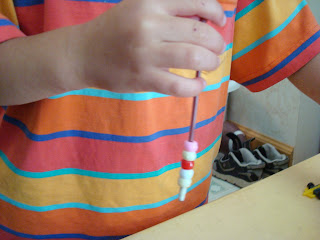


I love Discovery Toys, and one of my favorite products that has seen years of use already in our home is "Playful Patterns". These are 6 different colored foam pieces that can be placed on top of cards with various pictures on them. Some are quite easy to cover, while others are hard. Even our older children still love this activity! I am happy to say that Discovery Toys still sells this product. You can find it here.

A lap sized white board with a variety of colored markers is also a happy activity for our Little Man. I only let him do this one when the rest of us are using the other lapboards too, so that I can easily monitor his use of the markers. :-) We have 3 of these small whiteboards and we use them ALL the time ~ great for spelling and dictation!

Feltboard and felt shapes are pretty self-explanatory.
 We love wrap ups! These are neat little self correcting cards, where you match various things on the top and bottom of cards by wrapping a string around them. The string fits into little notches above or below each picture or word or letter. They are made for a variety of skills and levels. You can find them at most teacher supply stores or online such as here.

Whenever you're at WalMart, Target, children's consignment stores, or perhaps a more specialized store such as a teacher supply store, look for preschool activities that may be on sale. I always look for things that are colorful, self correcting, easy to manipulate, and look like they will last. We really like this "things that go together" activity. Little Man can do this all by himself!

One of my new acquisitions for this coming fall was a package of large buttons. We will use these for sorting, counting, and perhaps stringing.

I also really like these dot to dot lace ups because instead of numbers, they have the letters of the alphabet on them. You start at A, find B, then C, and so on.
The long answer, for those who DO wish to know the details, follows.
Before sharing the details of what we do with our babies, toddlers, and preschoolers, I want to share my personal feelings on this topic in general. Children are a blessing from the Lord. All children, at every age. Blessings are just that. Blessings! Not interruptions. Not annoyances. Think of other blessings in your life. Don't you rejoice over each blessing, big and little, that God allows into your life or your day? I know we all love our children, but when we have a plan in place to school older children, and curriculum that we are trying to get through in a specified amount of time, the temptation is very great at times to see our younger ones as interrupting the great things we are trying to do with our olders. At the very least, we can feel pulled in a hundred different directions. Distracted. Ask me how I know. :-) I still struggle with this at times!
It is so important to remember that even when the baby starts crying right in the middle of a really good reading lesson, or needs to be nursed at the same time your 2 year old just pee'd on the carpet, your 4 and 5 year olds are getting into a fist fight in the toyroom, and your 7 year old is crying over her math lesson, that THEY are the lesson. The curriculum you just researched and prayerfully purchased is not the real lesson. The stack of fantastic books waiting to be read is not the lesson. Your children are the lesson. And they are teaching you plenty while they themselves are learning from your response to them. And yes, the first sentence in this paragraph is a real life example. What did I do you ask? I laid the baby carefully on the floor, closed the math book and told the 7 year old she could take a break, ran downstairs to the toyroom and stopped the fight, popped in a video, threw a towel on the wet spot on the carpet, put a pullup on the 2 year old, and then sat down to nurse and enjoy the baby. I probably also either laughed or cried, I don't remember which!
You all know how fast your children are growing! Babies are babies for such a short time. Don't let the pressure of having to "perform" as a homeschooler rob you of the joy you should fully experience each time the Lord blesses your family with a new little person. Each child in the family needs to know that they are an integral part of the family, that you delight in them, that they bring you joy simply by being their little self, and that you are not looking for ways to get rid of them for a while, or shuffling them off to play by themselves while you do the important work of grammar and math and history. THEY ARE YOUR MOST IMPORTANT WORK!!!!!!
Okay, now that we have that settled I'll move on to the nitty gritty. :-)
We have had many different daily routines, depending on the ages of our children. I will gladly share what has worked for us at different stages, but there is no magic "formula" (oh, how I have often wished there were!). You will have to pray and adjust your routine for the ages and unique personalities of each of your children.
In my part 2 post I shared quite a bit about how we managed our day when we first started homeschooling for kindergarten. At that time we had a 5 year old, 3 year old, 2 year old, and infant. Let me just add here that someone gave me a great piece of advice way back then that I have always kept in mind, and that is to spend some time early in the day with the youngest of your children so that their little "emotional tanks" are full and they can more easily share you with their older siblings. When we had babies, they naturally got my full attention first thing in the morning during their morning nursing. I treasured these times with each of my babies! Not only did I love nursing, it also gave me a chance to pray over the day. After everyone else had eaten breakfast, we started our day with booktime. I would read books to all the kids who couldn't read for themselves (yes, even little tiny babies), while those who could read on their own or were interested in looking at pictures of other books were free to do so. In fact, we still start our school day this way!
At that time everyone still napped except the kindergartner. So we would have book time altogether, nature walks outside altogether, fun Laura Ingalls hands on type things altogether, our oldest would do math while the boys were doing table time (explained further down). And then when the younger ones were napping, the K'er and I would work on reading and phonics. This still gave her time for a rest period in her room, while I usually napped on the couch for 30 minutes.
All of our babies, from birth until about 18 or 20 months old, had what we called "playpen time". This was time that they spent in the playpen, with age appropriate toys. They were within earshot of me, but had to learn to entertain themselves with what was in the playpen. As they grew older and learned to throw things out of the playpen, that was to their detriment because then there was nothing to play with for the rest of playpen time! I did not play that game with our kids. So later, when we had 2 or 3 that were school age, the current baby would have playpen time while the older kids and I moved to the table for school.
Generally speaking, I moved our babies from my lap, to the playpen, to the swing, to the bouncy seat, back to my lap, to the floor, etc, in roughly 30 minute increments, with naps and eating in between. I tried to always give them tummy time on the floor so they could develop upper body strength. They also had time on their back. I vividly remember our now 5 year old, when he was a baby, lying on the family room floor mesmerized by the ceiling fan! Somewhere between 6 and 12 months it was fun to put the baby in the high chair and move them right to the table where we were schooling. They could try to grasp cheerios or play with a few teething toys and feel like they were a part of everything we were doing. All in all it was exceedingly easy to homeschool with a young baby. It got more challenging when the baby became mobile.
From 18-20 months on, we would graduate the babies from play pen time to room time. This was essentially the same thing only with a bigger space to play in. I made sure their room was baby proofed and entirely safe for them (furniture bolted to the wall, etc) and would rotate toys about once a week to keep it interesting. This was not something we did to "get rid of" the toddler for awhile so we could do school. This was an important part of the toddler's development, learning how to keep himself entertained without needing constant input from others. I would put on a music CD for them to listen to during roomtime, and tell them that "when the music stops mommy will come to get you." When I returned to their room I made sure to stay in there for a few minutes and ask what they did during roomtime, what they built or what they played with ("show me the line of cars you made....can you show me the red one?") so that I wasn't just "rescuing" them but showing interest in what they had done during my absence.
Group snack, play time outside, something fine motor, and more reading of books, with afternoon naps or rest times for everyone were also important elements of our daily routine.
Other things that have worked well:
The buddy system. Having older children spend time with younger ones, also in roughly 30 minute increments. This helps develop strong sibling bonds, and lets each child develop their "own" relationship with the baby or toddler. It also frees mom to work with one of the other children individually for a few minutes on reading or phonics.
Table time. Put 3 or 4 preschool-ish type activities in the middle of the table, start a 30 minute classical music CD, and tell everyone they have to stay at the table and do one of the activities as long as the music is playing. This helps develop the ability to focus on one thing at a time, even with distractions in the room. What kindergarten teacher wouldn't love to have incoming students who all had that ability!
I did and do utilize videos, but my personal rule for when they were all toddlers/preschoolers was no more than 30 minutes a day of screen time. Our current preschooler can go for days without any screen time, since he has 4 older siblings to entertain him! We did lots of pbs shows (Bob the Builder, Mr. Rogers neighborhood), VeggieTales videos, and educational videos such as The Letter Factory and The Word Factory by LeapFrog. In fact, I credit the Letter Factory with FINALLY teaching our third child his letter sounds!
Our routine has changed considerably since we don't have any babies or toddlers in the family any longer. Our youngest is 3 and is solidly a preschooler. He calls himself a "big boy" all the time. He spends his day right with us, doing age appropriate activities, or enjoying the buddy system with an older sibling. So the rest of this very long post will describe activities that a preschooler can do mostly independently.
PLEASE keep in mind that I have had years to make or acquire preschool activities. I often asked for specific things as Christmas or birthday gifts, and I made alot of our early activities for very little money. I would encourage those of you with young ones to spend time during the summers preparing activities for them to do during the school year. Start with things you know they would enjoy, but don't be afraid to stretch a little and try something "out there" too.
Here is my preschool cupboard. It's the end of the school year so it's just about time for its annual summer clean out. I pull one activity out of this cupboard every day for our Little Man to do at his very own school table (Little Tikes) next to our kitchen table where the rest of us are doing schoolwork. He does this for anywhere from 30 to 60 minutes.
One of his favorites is beading. We have several sizes of beads for various ages and abilites. The large chunky beads are great when you still have younger babies and are concerned about choking hazards. I found that stringing them onto string was often frustrating as the string wouldn't always "push" through the entire bead. So we also use plastic straws and pipe cleaners as "string" for these beads. For older children, pony beads on coffee stir sticks work well. I don't know why pony beads are called pony beads, but you can find a big tub of them at Michael's for cheap. I put masking tape on one end so the beads don't fall off. For 4's and 5's learning to recognize patterns is an important skill, so I made a few permanent patterns on some of the stir sticks and put masking tape on both ends. Our 3 year old cannot copy these patterns yet, he just has fun putting pony beads on the sticks. And that's a great strength building exercise for his little fingers!

Our third kind of bead is a jug of alphabet beads. These are super fun for older preschoolers or school aged children to practice making actual words on their necklaces.
I made a couple of beginning consonant sound games using file folders as game boards. We have one game that is for the sounds G, B, D, and L, and another game for the sounds S, F, T, M. There are several cards with pictures on them of things that begin with one of these sounds. The child draws a card and then moves his place holder to a square that has that letter sound on it. I made sure to draw both upper case and lower case letters on the game board, so the child would learn to recognize both. This is a great activity for an older sibling to do with a younger one! Our Little Man does not do this one yet, but our 5 year old played them last year in preschool and this year in kindergarten.
We have a few dozen puzzles, for various ages and abilites. The wooden ones with chunky handles on each piece are great for little hands. This is the puzzle shelf in my preschool cupboard.
I was very happy when our Little Man learned to do the foam Laurie puzzles on his own ~ I learned through trial and error that our children needed to be about 3 or 4 before they could do these with a minimum of frustration, but our Little Man loves these now! They are great for him to do while I am reading our history and literature outloud because they are completely quiet.
Last summer one of the school districts near us was throwing out a bunch of stuff that I was able to nab for our own use. One of the things they were throwing out was a large book full of laminated real life pictures of food. We punched all the food shapes out of the book, made 2 large "plates" out of posterboard, and have enjoyed building nutritious (or not) meals! During this same public school garbage day we were able to retrieve a working microscope. It's not super good quality, but it works and it came with a bunch of prepared slides and some blank slides. We couldn't figure out why the public school was getting rid of some of this stuff, but their loss is our gain! (my hubby said finally we get something for our tax dollars!)
Another favorite activity of ALL the kiddos is pegs and pegboards. This can keep them busy for hours. I purchased these from Discount School Supply. The pegboards came in a pack of 10, so a friend and I split the cost and we each got 5. Perfect!
Sorting is another great preschool activity. You can do this very easily by just using empty egg cartons as sorting trays and almost any small object can be sorted. Some of our choices are, from left to right, cuisenaire rods, pattern blocks, and plastic fish. Our Little Man is not a great sorter yet, he just has fun putting things into the egg receptacles and then pouring them out again!
I love Discovery Toys, and one of my favorite products that has seen years of use already in our home is "Playful Patterns". These are 6 different colored foam pieces that can be placed on top of cards with various pictures on them. Some are quite easy to cover, while others are hard. Even our older children still love this activity! I am happy to say that Discovery Toys still sells this product. You can find it here.
A lap sized white board with a variety of colored markers is also a happy activity for our Little Man. I only let him do this one when the rest of us are using the other lapboards too, so that I can easily monitor his use of the markers. :-) We have 3 of these small whiteboards and we use them ALL the time ~ great for spelling and dictation!
Feltboard and felt shapes are pretty self-explanatory.
We love wrap ups! These are neat little self correcting cards, where you match various things on the top and bottom of cards by wrapping a string around them. The string fits into little notches above or below each picture or word or letter. They are made for a variety of skills and levels. You can find them at most teacher supply stores or online such as here.Whenever you're at WalMart, Target, children's consignment stores, or perhaps a more specialized store such as a teacher supply store, look for preschool activities that may be on sale. I always look for things that are colorful, self correcting, easy to manipulate, and look like they will last. We really like this "things that go together" activity. Little Man can do this all by himself!

Another activity from the Laurie company. Love their products!
One of my new acquisitions for this coming fall was a package of large buttons. We will use these for sorting, counting, and perhaps stringing.
I also really like these dot to dot lace ups because instead of numbers, they have the letters of the alphabet on them. You start at A, find B, then C, and so on.

Other activities we do regularly that are not pictured:
Paint with water books
Magnets on cookie sheets
Sidewalk chalk on the patio
Dominos (we have a set that has different colored dots for each number ~ we use these for color matching, number matching, lining up, and just generally playing with!)
Play Dough (we do this with everyone ~ when the older kids are having a break)
Alphabet Bingo
Small stickers inside a circle that I draw on a piece of paper. I tell the child to fill up the whole circle with stickers. I draw small circles for younger children and large circles for older ones.
Cutting practice ~ draw zig zag lines on a piece of paper and have your preschooler practice cutting on the lines.
I hope something here can stimulate your own ideas and encourage you that it IS possible to include your younger ones in your homeschooling experience in a way that is positive for your whole family!
Monday, May 26, 2008
Some of our Family's Curriculum Choices and the "why" behind them (part 4)
If you've read part 3, then you know that we use Tapestry of Grace as the main framework for our studies. This incorporates history, literature, geography, vocabulary, writing, and Bible/worldview. It is fabulous, fabulous, fabulous ~ can't say enough good things about Tapestry! Here are some of our other choices and why we chose them. I frequently get asked about curriculum, and I do think it is helpful sometimes to hear exactly what others use, what they like/don't like, and why it works for them.
Math ~ We began using Miquon math at the beginning of our homeschool journey, and really loved it. It was non-traditional, utilized manipulatives for the early years, and used a discovery approach. That is, the student would work with the manipulatives and work through each page and usually "discover" on their own the math principles being taught without needing a lecture or lots of examples. It was also very inexpensive, about $10 per workbook. Miquon only goes through third grade, so we knew we would have to switch curriculum in fourth grade.
At the end of our daughter's third grade year I began researching other math options. I felt it would be good for her to have exposure to a more "traditional" approach since she had used a non traditional approach for 4 years. At our annual homeschool book fair I was able to lay out the fourth grade Horizons book, Saxon math book, and Abeka book side by side and look them all over in depth. I was very impressed with Abeka, and after having my hubby look it over also, and praying for direction, we purchased all the fourth grade Abeka math materials for a total of about $90. Meanwhile our younger boys were all still using Miquon.
Well, Abeka is a great curriculum for some, but it did not work for our daughter. She had a very difficult transition to the traditional "spiral" approach to math, which does not teach for mastery because it spirals around to the same concept over and over throughout the year. A new concept was introduced every couple of pages, and then a small amount of practice was done on the new concept along with review problems from many different previous lessons. On any given page our daughter was doing about 5 different operations plus story problems. The effort it took to switch gears so many times during one lesson was extremely frustrating. There were many tears and many compromises (okay, do only the even numbered problems) and our daughter went from loving math to hating it. I knew I had to do something.
At our homeschool book fair in March of that year, I went straight to the Math U See booth. I had heard good things about this curriculum for years, and I knew it taught for mastery. Generally speaking, an entire year is spent on addition and subtraction, another year on multiplication and division, another year on fractions, and so on. Is it founded on the belief that it is as important to know which operation to perform on any given problem as it is to know how to do that operation. For instance, in this story problem, "There were 4 children and 12 cookies. How many cookies does each child get?", even if the student knows *how* to divide, if he doesn't know *when* to divide he is stuck.
We had previously ordered the free demo dvd, and when we were about 5 minutes into it my hubby was completely sold! He said let's switch all the children right now (one of the beautiful things about homeschooling!). So in the middle of March we put away our $90 worth of Abeka and our Miquon workbooks and started everyone on MathUSee at their appropriate levels. In the 15 months since then, it has been WONDERFUL to see the love of Math return and to see concepts really clicking with not only our daughter but our boys as well. Each lesson is taught by the Math U See founder by way of dvd, and our children really enjoy listening to him! There are 3 pages of practice for each new lesson, as well as 3 pages of cumulative review, so the students are free to do as many or as few of these as they need for total mastery.
We love, love, love Math U See! And this experience was a good lesson for me that even though we had carefully researched and prayed over our Abeka decision, we didn't really know if it was going to work out until our daughter actually start using it. And since it wasn't working, how thankful I am that we were free to switch gears!
Grammar ~ I have had a very eclectic approach to teaching grammar. In other words, we've tried a lot of different things! We used Rod and Staff English with our daughter for 2nd and 3rd grade, and were mostly happy with it. It did give her a pretty solid foundation, but since the student text was non-consumable she had to write her answers in a separate notebook, and the action of moving her eyes back and forth, finding her place in the textbook again after writing a word in her notebook, was sometimes quite frustrating. We did large portions of it orally, but that required my direct involvement. By fourth grade I was looking for something that she could do a little more independently.
Tapestry recommends the use of Easy Grammar, and so I decided to give that a try. This curriculum is very appropriately named! It was easy! It uses the prepositional approach to teaching grammar, first teaching prepositions and teaching students how to recognize a prepositional phrase. Usually, the subject, verb and object are NOT found within the prepositional phrase, so if the student crosses this out then right off the bat they have an easier time finding the other things they are looking for. Our daughter has used this for fourth and fifth grade.
Meanwhile, I used a more "natural" approach with the boys. When L and G were in 1st and 2nd grades respectively, we made word banks out of 3 by 5 cards and recipes boxes. We put color coded dots on each card to specify what part of speech it was, and we made dividers for their recipe boxes. This suggestion was straight out of our Tapestry curriculum! And what a hit it was! On the first day of school that year, when hubby came home from work, our then 6 year old L went running to the front door clutching his recipe box to his chest and said excitedly, "Daddy! I made a word bank today!!". :-)
We added to the word bank all fall, eventually covering all 8 parts of speech. Then I made a little stand up tray out of a cut piece of posterboard, and we made sentences with our 3x5 cards. I labeled the first part of the posterboard tray "subject" and the last part "predicate" and would just talk about those words while the boys built their sentences so they became familiar with the language of grammar. We talked about capitalization and punctuation. This past year we did dictation on little lap white boards, where I said a sentence outloud and they each had to write it, attempting to spell each word correctly, start the sentence with a capital letter and end it with a period.
And that is all the grammar they have ever had! This coming fall our fourth grade son G will start Easy Grammar as his sister did before him, while our third grade son L will help his younger first grade brother C make his own word bank.
Foreign Language/Grammar ~ Our daughter, who will be starting 6th grade this fall, will begin a (Lord willing) 3 year study of latin. Why study latin? There are several reasons. My friend Laurie has written a wonderful post on "why study latin?" on her blog. You can find that here. For us there are 4 primary reasons. First of all, about 60% of the english language has latin roots, and even words that we have borrowed from other languages had *their* roots in latin, so an understanding of latin will give us a better understanding of english. Secondly, since latin is no longer spoken and therefore does not change over time (some refer to it as a "dead language") it is used heavily in the sciences, for instance in animal classification. It is also used heavily in the medical field. An understanding of latin now will prepare our children better for high school and college level sciences, and may be something they utilize in their work environment later. Thirdly, when we come upon latin phrases/verses in our history studies, or in Bible study, we will know what they mean! And we can better understand the men and women who shaped history, particularly our founding fathers, who all had a strong foundation in latin. And lastly, since many latin words were also borrowed by several European languages, a foundation in latin will better prepare our children to study a foreign language of their choice in high school.
So I set out this spring to decide on a latin curriculum. Come to find out, there is a huge "how to teach latin" industry within the homeschool community!! Who knew??? I kid you not when I say there are at least a dozen different latin curriculums to choose from. After much research, prayer, discussion with hubby, more research, bugging my friends who use various things, more prayer, and more research, we finally decided on The Latin Road to English Grammar. We wanted a curriculum that had a heavy emphasis on latin grammar and didn't just teach a few vocabulary words each week, and we wanted something that wasn't tied to a lot of ancient history since that is not where we are right now in our history cycle. I also wanted something that came with teaching dvd's so that I could learn proper pronunciation, since I have never studied latin before. We have a lot of peace about our choice, and I am really hoping it is the right one for us! I was able to purchase the entire volume 1 set used, so it was not a huge expense. Another blessing! I have been told by several others who use LRTEG that the learning of latin grammar so solidifies and enhances the understanding of english grammar that a separate english grammar program is not needed. So we do not have plans at this point for any other grammar for our 6th grader except LRTEG.
Writing ~ I have already mentioned our writing program several times, Institute for Excellence in Writing, or IEW. I just wanted to add here that God is so good to lead us to a program that we can use with ALL our children for the REST of their school careers! No more writing purchases that end up sitting on the bookshelf unused!
Science ~ I will freely admit right here that I dropped the ball on formal science this year. I purchased "Exploring Creation with Zoology 1: Flying Creatures of the Fifth Day" from this publisher to use, but we only did chapter 1. Awful, I know. We do so much informal science that I decided to let the guilt go. I am correcting this problem this upcoming year however, by teaching this class myself at our homeschool co-op! We will use the notebooking method while working through this book, which I will address later.
Handwriting/Penmanship ~ We have used 3 different handwriting programs so far, and one year we used all 3 of them at the same time, with different children! Our daughter has only used A Reason for Handwriting, and it has worked for her beautifully. She used their cursive book in third grade and has been writing in cursive ever since. Our next 2 boys had more of a problem with fine motor skills and a weak pincher grasp, so for them I used Handwriting Without Tears. It has been PERFECT for them. I use it this year with C also, and he and L will continue with it next year. Last year I used Draw Write Now with our son G because his printing was so neat and he had no trouble staying within the lines. This fall in fourth grade he will learn cursive with A Reason for Handwriting. Our daughter practiced her cursive penmanship this year by copying famous quotes of Benjamin Franklin.
As I look back at the last 7 years, all the different tools for learning we have used, the different styles that fit us for different reasons at different times, and what God has led us to for this upcoming year, I am so humbled and GRATEFUL that He is in charge of our little home school! If nothing else, I am learning that I truly can depend on Him, for all our choices, for each of the children, as we progress through each grade. He is so good. Thank you Lord!
Math ~ We began using Miquon math at the beginning of our homeschool journey, and really loved it. It was non-traditional, utilized manipulatives for the early years, and used a discovery approach. That is, the student would work with the manipulatives and work through each page and usually "discover" on their own the math principles being taught without needing a lecture or lots of examples. It was also very inexpensive, about $10 per workbook. Miquon only goes through third grade, so we knew we would have to switch curriculum in fourth grade.
At the end of our daughter's third grade year I began researching other math options. I felt it would be good for her to have exposure to a more "traditional" approach since she had used a non traditional approach for 4 years. At our annual homeschool book fair I was able to lay out the fourth grade Horizons book, Saxon math book, and Abeka book side by side and look them all over in depth. I was very impressed with Abeka, and after having my hubby look it over also, and praying for direction, we purchased all the fourth grade Abeka math materials for a total of about $90. Meanwhile our younger boys were all still using Miquon.
Well, Abeka is a great curriculum for some, but it did not work for our daughter. She had a very difficult transition to the traditional "spiral" approach to math, which does not teach for mastery because it spirals around to the same concept over and over throughout the year. A new concept was introduced every couple of pages, and then a small amount of practice was done on the new concept along with review problems from many different previous lessons. On any given page our daughter was doing about 5 different operations plus story problems. The effort it took to switch gears so many times during one lesson was extremely frustrating. There were many tears and many compromises (okay, do only the even numbered problems) and our daughter went from loving math to hating it. I knew I had to do something.
At our homeschool book fair in March of that year, I went straight to the Math U See booth. I had heard good things about this curriculum for years, and I knew it taught for mastery. Generally speaking, an entire year is spent on addition and subtraction, another year on multiplication and division, another year on fractions, and so on. Is it founded on the belief that it is as important to know which operation to perform on any given problem as it is to know how to do that operation. For instance, in this story problem, "There were 4 children and 12 cookies. How many cookies does each child get?", even if the student knows *how* to divide, if he doesn't know *when* to divide he is stuck.
We had previously ordered the free demo dvd, and when we were about 5 minutes into it my hubby was completely sold! He said let's switch all the children right now (one of the beautiful things about homeschooling!). So in the middle of March we put away our $90 worth of Abeka and our Miquon workbooks and started everyone on MathUSee at their appropriate levels. In the 15 months since then, it has been WONDERFUL to see the love of Math return and to see concepts really clicking with not only our daughter but our boys as well. Each lesson is taught by the Math U See founder by way of dvd, and our children really enjoy listening to him! There are 3 pages of practice for each new lesson, as well as 3 pages of cumulative review, so the students are free to do as many or as few of these as they need for total mastery.
We love, love, love Math U See! And this experience was a good lesson for me that even though we had carefully researched and prayed over our Abeka decision, we didn't really know if it was going to work out until our daughter actually start using it. And since it wasn't working, how thankful I am that we were free to switch gears!
Grammar ~ I have had a very eclectic approach to teaching grammar. In other words, we've tried a lot of different things! We used Rod and Staff English with our daughter for 2nd and 3rd grade, and were mostly happy with it. It did give her a pretty solid foundation, but since the student text was non-consumable she had to write her answers in a separate notebook, and the action of moving her eyes back and forth, finding her place in the textbook again after writing a word in her notebook, was sometimes quite frustrating. We did large portions of it orally, but that required my direct involvement. By fourth grade I was looking for something that she could do a little more independently.
Tapestry recommends the use of Easy Grammar, and so I decided to give that a try. This curriculum is very appropriately named! It was easy! It uses the prepositional approach to teaching grammar, first teaching prepositions and teaching students how to recognize a prepositional phrase. Usually, the subject, verb and object are NOT found within the prepositional phrase, so if the student crosses this out then right off the bat they have an easier time finding the other things they are looking for. Our daughter has used this for fourth and fifth grade.
Meanwhile, I used a more "natural" approach with the boys. When L and G were in 1st and 2nd grades respectively, we made word banks out of 3 by 5 cards and recipes boxes. We put color coded dots on each card to specify what part of speech it was, and we made dividers for their recipe boxes. This suggestion was straight out of our Tapestry curriculum! And what a hit it was! On the first day of school that year, when hubby came home from work, our then 6 year old L went running to the front door clutching his recipe box to his chest and said excitedly, "Daddy! I made a word bank today!!". :-)
We added to the word bank all fall, eventually covering all 8 parts of speech. Then I made a little stand up tray out of a cut piece of posterboard, and we made sentences with our 3x5 cards. I labeled the first part of the posterboard tray "subject" and the last part "predicate" and would just talk about those words while the boys built their sentences so they became familiar with the language of grammar. We talked about capitalization and punctuation. This past year we did dictation on little lap white boards, where I said a sentence outloud and they each had to write it, attempting to spell each word correctly, start the sentence with a capital letter and end it with a period.
And that is all the grammar they have ever had! This coming fall our fourth grade son G will start Easy Grammar as his sister did before him, while our third grade son L will help his younger first grade brother C make his own word bank.
Foreign Language/Grammar ~ Our daughter, who will be starting 6th grade this fall, will begin a (Lord willing) 3 year study of latin. Why study latin? There are several reasons. My friend Laurie has written a wonderful post on "why study latin?" on her blog. You can find that here. For us there are 4 primary reasons. First of all, about 60% of the english language has latin roots, and even words that we have borrowed from other languages had *their* roots in latin, so an understanding of latin will give us a better understanding of english. Secondly, since latin is no longer spoken and therefore does not change over time (some refer to it as a "dead language") it is used heavily in the sciences, for instance in animal classification. It is also used heavily in the medical field. An understanding of latin now will prepare our children better for high school and college level sciences, and may be something they utilize in their work environment later. Thirdly, when we come upon latin phrases/verses in our history studies, or in Bible study, we will know what they mean! And we can better understand the men and women who shaped history, particularly our founding fathers, who all had a strong foundation in latin. And lastly, since many latin words were also borrowed by several European languages, a foundation in latin will better prepare our children to study a foreign language of their choice in high school.
So I set out this spring to decide on a latin curriculum. Come to find out, there is a huge "how to teach latin" industry within the homeschool community!! Who knew??? I kid you not when I say there are at least a dozen different latin curriculums to choose from. After much research, prayer, discussion with hubby, more research, bugging my friends who use various things, more prayer, and more research, we finally decided on The Latin Road to English Grammar. We wanted a curriculum that had a heavy emphasis on latin grammar and didn't just teach a few vocabulary words each week, and we wanted something that wasn't tied to a lot of ancient history since that is not where we are right now in our history cycle. I also wanted something that came with teaching dvd's so that I could learn proper pronunciation, since I have never studied latin before. We have a lot of peace about our choice, and I am really hoping it is the right one for us! I was able to purchase the entire volume 1 set used, so it was not a huge expense. Another blessing! I have been told by several others who use LRTEG that the learning of latin grammar so solidifies and enhances the understanding of english grammar that a separate english grammar program is not needed. So we do not have plans at this point for any other grammar for our 6th grader except LRTEG.
Writing ~ I have already mentioned our writing program several times, Institute for Excellence in Writing, or IEW. I just wanted to add here that God is so good to lead us to a program that we can use with ALL our children for the REST of their school careers! No more writing purchases that end up sitting on the bookshelf unused!
Science ~ I will freely admit right here that I dropped the ball on formal science this year. I purchased "Exploring Creation with Zoology 1: Flying Creatures of the Fifth Day" from this publisher to use, but we only did chapter 1. Awful, I know. We do so much informal science that I decided to let the guilt go. I am correcting this problem this upcoming year however, by teaching this class myself at our homeschool co-op! We will use the notebooking method while working through this book, which I will address later.
Handwriting/Penmanship ~ We have used 3 different handwriting programs so far, and one year we used all 3 of them at the same time, with different children! Our daughter has only used A Reason for Handwriting, and it has worked for her beautifully. She used their cursive book in third grade and has been writing in cursive ever since. Our next 2 boys had more of a problem with fine motor skills and a weak pincher grasp, so for them I used Handwriting Without Tears. It has been PERFECT for them. I use it this year with C also, and he and L will continue with it next year. Last year I used Draw Write Now with our son G because his printing was so neat and he had no trouble staying within the lines. This fall in fourth grade he will learn cursive with A Reason for Handwriting. Our daughter practiced her cursive penmanship this year by copying famous quotes of Benjamin Franklin.
As I look back at the last 7 years, all the different tools for learning we have used, the different styles that fit us for different reasons at different times, and what God has led us to for this upcoming year, I am so humbled and GRATEFUL that He is in charge of our little home school! If nothing else, I am learning that I truly can depend on Him, for all our choices, for each of the children, as we progress through each grade. He is so good. Thank you Lord!
Friday, May 23, 2008
Determining the Homeschool Style that fit our Family (part 3)
After 7 years of homeschooling, I have noticed that many new homeschoolers have a tendency to immediately begin worrying about curriculum, what to use with their children and how to make sure they are keeping in step with all their children would learn in certain grades if they were in public school. While this is somewhat natural, and I have had to guard against this myself, I believe it is putting the cart before the horse. There are at least as many different ways to homeschool as there are people reading this, so before worrying about specific curriculum choices it would be well to READ EVERYTHING YOU CAN GET YOUR HANDS ON ABOUT DIFFERENT HOMESCHOOLING STYLES (no, I'm not really shouting, just capitalizing for emphasis!!).
What people may not realize is that every single textbook, every single curriculum ~ yes, even math ~ is written from either a particular worldview or the viewpoint that their approach is the "right" way to teach that particular subject. Sometimes the approach is subtle and seemingly hidden, but often it is very identifiable if you know what to look for. When you go to a homeschool conference or bookfair it is easy to be overwhelmed with the sheer number of choices! Which is something I'm grateful for, as our predecessors had very little choice when it came to homeschool curriculum. But if you know what style of homeschooling you're aiming for, and what your goals are ahead of time, you can confidently walk past those vendors that offer materials not in line with your style and goals, and focus only on those that do.
So what are the major homeschooling styles?
This has been ably addressed by those much more expert than I, so I will only briefly highlight a few here. An excellent resource that describes all the homeschooling styles in great detail and even gives you a checklist to know if this is the style for you, is the book 100 Top Picks for Homeschool Curriculum by Cathy Duffy. Love, love, love this book!
The traditional style includes using textbooks and/or workbooks, and will use a distinct book for each subject area. These books are usually written for use in regular school classrooms. This approach enables a home school to function much like a regular public or private classroom. Some people find this method easier for record keeping, scheduling, and accountability.
The Charlotte Mason approach is named for its founder, a British school teacher who lived during the late 1800's, early 1900's. After years of experience, she determined that there were better ways of teaching children than traditional methods. To quote Cathy Duffy, "she believed in a child's innate ability and desire to learn and the need for teachers to restrain themselves from controlling all learning. She was not an advocate of unschooling, but of directed learning as well as teaching a child self discipline and good habits." This approach is characterized by lots of outdoor nature study, the use of narration (telling back) after reading/learning, and the reading of quality literature. An excellent resource for learning more about this homeschooling style is The Charlotte Mason Companion by Karen Andreola.
The classical style is based on models that go all the way back to the Ancient Greek and Roman civilizations. Every subject area is taught in three stages that coincide with a child's development. The grammar stage involves the basic structure, skills and knowledge of any subject (for math that would include learning basic math facts, for grammar learning parts of speech, for history learning the names of major events and people, etc). The logic or dialectic stage builds on this foundation, and students begin analyzing information and making connections. The rhetoric stage builds on this even further, the students have assimilated knowledge, thought about what they have learned, and can now express their own ideas through speech and writing at what would likely be considered adult levels. This style is characterized by the reading of "real books" and by socratic discussions. A wonderful book that details this approach is Teaching the Trivium, Christian Homeschooling in a Classical Style.
The Unit Study approach is based on a theme that is used across subject areas. Rather than studying each subject separately, information is integrated and taught within the unifying theme. This style is characterized by the use of "real books" as well as hands on activities, and a high degree of direct parent involvement.
There are several other styles as well, including relaxed homeschooling, unschooling, literature based, and the eclectic approach, which is a combination of two or more of the above philosophies. Many homeschoolers I know, including myself, would fall into this category!
When we began homeschooling with only younger children, my two primary goals were to have lots of time to be outside, and to read lots of good books. So the Charlotte Mason style really appealed to me. We would read, and talk about what we were reading. We would go on a walk in the neighborhood and talk about what we saw. I consciously steered clear of many workbooks in the early years, and also tried to pick classic children's books to read to the kids that had stood the test of time. If it was published before 1960 we probably read it!
The unit study approach also appealed to me, and as I did more reading and studying about learning styles, the classical style also resonated with me. Over the years this has merged into the mostly classical but eclectic style that our family has today. Because we are first learning foundational skills in all subject areas and then building on them as our children grow (the classical model), our children may not know all the same things at the same time as their institutionally schooled counterparts, and vice versa. And this is okay! There are no curriculum police that are going to come to our door and demand to know why we didn't study a certain thing at a certain time. We are free to chart our own course. How I thank God for that!
I think the main reason that the classical model has come to fit us so well, is that my hubby and I are not as concerned with which FACTS our children remember from their school experience, as that they be able to THINK for themselves. That they will be able to take in information, recognize whether it is truth or falsehood, process it, think creatively about it, and articulate its truth or error in an effective way that edifies or persuades others. This is our number one educational/life goal.
We were thrilled to find Tapestry of Grace about this time two years ago. Tapestry is a Biblically based classical curriculum, that allows all our children to study the same time period of history together, each at their own level or stage of learning. Our 5 year old and just turned 8 year old are at the lower grammar level, our 9 year old is at the upper grammar level, and our 11 year old is just entering the dialectic stage. It has been thrilling this past school year to see the progression of stages as each of our children has read (or been read to), discussed, and written or narrated about the same material. Marcia Somerville, author of Tapestry, always says "read, think, write." We try to do this every day!
As well as being a classical curriculum, Tapestry also incorporates the unit study approach. There are hands on activities listed as options for each week, as well as vocabulary words that relate to the history and literature being read, and map work that coincides with history. Of course, the parent/teacher is free to pick and choose which of these things to utilize, and what to ignore. Something else I have to repeat to myself frequently is that "I am the master of the curriculum, not its slave." New homeschoolers, or those considering homeschooling, repeat after me......"I do not have to do it all."
We switched from Sonlight to Tapestry two years ago, and it has definitely been the right fit for us! But just because something works for us doesn't mean it will work well for you. Each family is so unique and has their own goals and dynamic. So please do read and think and pray, and then decide with God's help on your own special style!
What people may not realize is that every single textbook, every single curriculum ~ yes, even math ~ is written from either a particular worldview or the viewpoint that their approach is the "right" way to teach that particular subject. Sometimes the approach is subtle and seemingly hidden, but often it is very identifiable if you know what to look for. When you go to a homeschool conference or bookfair it is easy to be overwhelmed with the sheer number of choices! Which is something I'm grateful for, as our predecessors had very little choice when it came to homeschool curriculum. But if you know what style of homeschooling you're aiming for, and what your goals are ahead of time, you can confidently walk past those vendors that offer materials not in line with your style and goals, and focus only on those that do.
So what are the major homeschooling styles?
This has been ably addressed by those much more expert than I, so I will only briefly highlight a few here. An excellent resource that describes all the homeschooling styles in great detail and even gives you a checklist to know if this is the style for you, is the book 100 Top Picks for Homeschool Curriculum by Cathy Duffy. Love, love, love this book!
The traditional style includes using textbooks and/or workbooks, and will use a distinct book for each subject area. These books are usually written for use in regular school classrooms. This approach enables a home school to function much like a regular public or private classroom. Some people find this method easier for record keeping, scheduling, and accountability.
The Charlotte Mason approach is named for its founder, a British school teacher who lived during the late 1800's, early 1900's. After years of experience, she determined that there were better ways of teaching children than traditional methods. To quote Cathy Duffy, "she believed in a child's innate ability and desire to learn and the need for teachers to restrain themselves from controlling all learning. She was not an advocate of unschooling, but of directed learning as well as teaching a child self discipline and good habits." This approach is characterized by lots of outdoor nature study, the use of narration (telling back) after reading/learning, and the reading of quality literature. An excellent resource for learning more about this homeschooling style is The Charlotte Mason Companion by Karen Andreola.
The classical style is based on models that go all the way back to the Ancient Greek and Roman civilizations. Every subject area is taught in three stages that coincide with a child's development. The grammar stage involves the basic structure, skills and knowledge of any subject (for math that would include learning basic math facts, for grammar learning parts of speech, for history learning the names of major events and people, etc). The logic or dialectic stage builds on this foundation, and students begin analyzing information and making connections. The rhetoric stage builds on this even further, the students have assimilated knowledge, thought about what they have learned, and can now express their own ideas through speech and writing at what would likely be considered adult levels. This style is characterized by the reading of "real books" and by socratic discussions. A wonderful book that details this approach is Teaching the Trivium, Christian Homeschooling in a Classical Style.
The Unit Study approach is based on a theme that is used across subject areas. Rather than studying each subject separately, information is integrated and taught within the unifying theme. This style is characterized by the use of "real books" as well as hands on activities, and a high degree of direct parent involvement.
There are several other styles as well, including relaxed homeschooling, unschooling, literature based, and the eclectic approach, which is a combination of two or more of the above philosophies. Many homeschoolers I know, including myself, would fall into this category!
When we began homeschooling with only younger children, my two primary goals were to have lots of time to be outside, and to read lots of good books. So the Charlotte Mason style really appealed to me. We would read, and talk about what we were reading. We would go on a walk in the neighborhood and talk about what we saw. I consciously steered clear of many workbooks in the early years, and also tried to pick classic children's books to read to the kids that had stood the test of time. If it was published before 1960 we probably read it!
The unit study approach also appealed to me, and as I did more reading and studying about learning styles, the classical style also resonated with me. Over the years this has merged into the mostly classical but eclectic style that our family has today. Because we are first learning foundational skills in all subject areas and then building on them as our children grow (the classical model), our children may not know all the same things at the same time as their institutionally schooled counterparts, and vice versa. And this is okay! There are no curriculum police that are going to come to our door and demand to know why we didn't study a certain thing at a certain time. We are free to chart our own course. How I thank God for that!
I think the main reason that the classical model has come to fit us so well, is that my hubby and I are not as concerned with which FACTS our children remember from their school experience, as that they be able to THINK for themselves. That they will be able to take in information, recognize whether it is truth or falsehood, process it, think creatively about it, and articulate its truth or error in an effective way that edifies or persuades others. This is our number one educational/life goal.
We were thrilled to find Tapestry of Grace about this time two years ago. Tapestry is a Biblically based classical curriculum, that allows all our children to study the same time period of history together, each at their own level or stage of learning. Our 5 year old and just turned 8 year old are at the lower grammar level, our 9 year old is at the upper grammar level, and our 11 year old is just entering the dialectic stage. It has been thrilling this past school year to see the progression of stages as each of our children has read (or been read to), discussed, and written or narrated about the same material. Marcia Somerville, author of Tapestry, always says "read, think, write." We try to do this every day!
As well as being a classical curriculum, Tapestry also incorporates the unit study approach. There are hands on activities listed as options for each week, as well as vocabulary words that relate to the history and literature being read, and map work that coincides with history. Of course, the parent/teacher is free to pick and choose which of these things to utilize, and what to ignore. Something else I have to repeat to myself frequently is that "I am the master of the curriculum, not its slave." New homeschoolers, or those considering homeschooling, repeat after me......"I do not have to do it all."
We switched from Sonlight to Tapestry two years ago, and it has definitely been the right fit for us! But just because something works for us doesn't mean it will work well for you. Each family is so unique and has their own goals and dynamic. So please do read and think and pray, and then decide with God's help on your own special style!
Subscribe to:
Posts (Atom)


